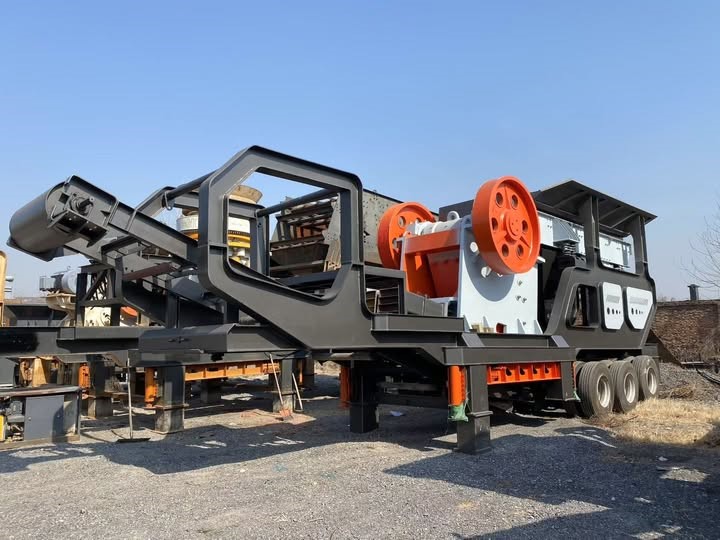
Founded in 1987, Liming Heavy Industry specializes in the production of stationary crushers in medium and large models, mobile crushing plants, and ball mills. With over 30 years of technical experience, the company adopts advanced production technologies from the United States, Germany, Australia, and other countries. The company's professionalism and product quality are comparable to well-known international brands in the industry.
The most expensive mistake in mineral beneficiation is relying on a ball mill to do a crusher’s job. During a plant audit at a high-altitude porphyry copper mine in Chile this May 2025, the bottleneck was obvious: the secondary circuit was passing 25mm rock to the grinding stage. The ball mills were consuming massive amounts of electricity just to pulverize coarse ore, destroying the plant’s production-to-cost ratio. A mathematically sound Copper Ore Processing Flow Chart must enforce a strict “more crushing, less grinding” mandate to protect downstream assets.
Primary Fracture: Anchoring the ROM Feed
The primary jaw crusher sets the volumetric pulse for the entire downstream circuit. If it bridges, the plant starves.
The foundation of the flow chart begins with the run-of-mine (ROM) feed. Copper porphyry is notoriously hard and abrasive. The C6X125 jaw crusher anchors this primary stage, designed specifically to absorb the kinetic shock of 800mm boulders. By reducing this massive feed to a consistent <200mm profile, the primary jaw physically guarantees that the downstream secondary cone crusher’s feed throat will not bridge or choke.
Architects must synchronize the vibratory feeder with the jaw’s amp draw. Overfeeding the primary stage causes localized packing in the chamber, forcing the toggle plate to endure fatal stress. A controlled, steady flow out of the primary stage is the only way to establish a stable mass balance across the entire conveyor network.
Secondary and Tertiary Lamination: “More Crushing, Less Grinding”
The core philosophy of modern copper processing is transferring the reduction work from the inefficient ball mill to the highly efficient cone crusher. Enforcing this architecture via an HPT300 multi-cylinder hydraulic cone crusher guarantees a strict output.
The hydraulic cone utilizes a high-speed 800 rpm eccentric rotation to initiate “stone-on-stone” laminated crushing. This does not just reduce the size of the rock; it induces kinetic micro-fractures along the copper porphyry grain boundaries. This pre-weakening enhances downstream flotation recovery rates before the ore even reaches the chemical liberation stage. Driving the ore down to a strict -12mm profile drops the downstream ball mill’s energy draw by up to 18%.
Synchronized Equipment Matrix for Copper Beneficiation
A flow chart is useless without the hardware capable of enforcing its volumetric limits.
Process Stage
Recommended Equipment
Capacity (tph)
Power (kW)
Architectural Limit (Max Feed)
Primary Fracture
C6X125 Jaw Crusher
230-760
160
800 mm
Secondary Crushing
HPT300 Cone (Standard)
110-440
250
230 mm
Tertiary Crushing
HPT300 Cone (Short Head)
110-440
250
100 mm
Closed-Circuit Screening
S5X2460-3 Vibrating Screen
100-800
30
200 mm
Notice the synergy between the HPT300 short head and the S5X screen. The screen acts as the absolute gatekeeper for the ball mill, ensuring no oversized rock bypasses the tertiary loop. This hardware synchronization dictates the hardware amortization cycle of the entire plant.
The screen sifts the material; anything under 12mm proceeds to the ball mill, while recirculating 20-25% of the +12mm oversize back to the cone crusher. This closed-circuit loop physically prevents coarse porphyry from entering the grinding phase and destroying the ball mill’s steel media, securing the operational viability of the beneficiation process.
Mass Balance Diagnostics & Ball Mill Starvation Post-Mortem
What physical evidence on the ball mill indicates a failure in the upstream crushing flow chart?
I inspected a grinding circuit last month where the steel balls were severely deformed and the liner plates were cracked. This is the direct result of the tertiary crusher passing +25mm rock. The mill was acting as an impact crusher instead of an attrition grinder, destroying the media.
Historically, why did older copper plants struggle with the “more crushing, less grinding” rule?
Decades ago, spring cone crushers lacked the hydraulic clamping force necessary to maintain a tight Closed Side Setting (CSS) under heavy copper ore loads. The adjustment rings would lift, allowing coarse rock to bypass the crushing zone. Modern multi-cylinder hydraulic units maintain absolute rigidity.
Why must the primary jaw crusher’s output strictly match the secondary cone’s feed throat geometry?
Do not rely on the conveyor belt to fix a size mismatch. If the jaw outputs 250mm rock into a cone designed for a 230mm maximum feed, the material will bridge above the mantle. This instantly starves the cone, dropping the production-to-cost ratio to zero until manually cleared.
How does closed-circuit screening mathematics affect the tertiary cone’s power draw?
Calculating the mass flow proves that a 25% recirculating load keeps the HPT300 operating in a continuous “choke-fed” state. This constant material density stabilizes the 250 kW amp draw and maximizes inter-particle laminated crushing, which is impossible in an open-circuit, partially-fed chamber.
Enforce the -12mm Mandate to Accelerate Payback
The physics of copper beneficiation are unforgiving. If your Copper Ore Processing Flow Chart fails to utilize a strict closed-circuit tertiary loop, you are forcing your ball mills to consume exorbitant amounts of electrical power to grind oversized rock. Next month, if you continue to feed +25mm ore into your grinding circuit, the severe wear on your steel media and the resulting drop in monomeric dissociation will cripple your capital payback velocity. Enforce the “more crushing, less grinding” architecture immediately.