Founded in 1987, Liming Heavy Industry specializes in the production of stationary crushers in medium and large models, mobile crushing plants, and ball mills. With over 30 years of technical experience, the company adopts advanced production technologies from the United States, Germany, Australia, and other countries. The company's professionalism and product quality are comparable to well-known international brands in the industry.
The Role of the Jaw Crusher in an Aggregate Production Line: The Unshakable Primary Cornerstone
January 28th 2026
For any modern aggregate (sand and gravel) production line, efficiency, cost control, and final product quality are paramount. At the heart of this process, one piece of equipment plays a fundamental and irreplaceable role: the Jaw Crusher. This article explores the critical positioning of the jaw crusher within the aggregate production circuit and why it remains the preferred choice for primary crushing.
The Foundational Stage: Primary Crushing
The first and most crucial stage in any aggregate plant is primary crushing. Here, large raw materials (run-of-mine rock, large boulders, or demolition concrete) need to be reduced to a manageable size for further processing. This is the exclusive domain of the jaw crusher.
Its primary functions are:
Size Reduction: To break down large feed material (often up to 1.5 meters in diameter) into smaller rocks, typically under 200-250mm.
Preparing Feed: To create a uniform and optimally sized feed for the secondary crusher (usually a cone crusher or impact crusher). Consistent feed size is critical for the efficiency and longevity of downstream equipment.
Toughness Handling: To withstand the immense stress and abrasion from processing hard, abrasive materials like granite, basalt, or quartzite without failure.
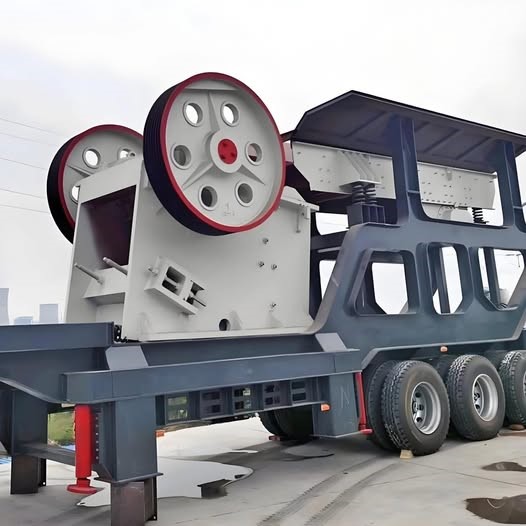
Jaw Crusher
Key Positioning Advantages of the Jaw Crusher
Why is the jaw crusher so uniquely suited for this first line of defense? Its positioning is built on several undeniable advantages:
1. Unmatched Robustness and Simplicity: The jaw crusher’s design is mechanically simple and incredibly robust. Its fixed and movable jaw plates create a “V” cavity that applies tremendous compressive force to break rock. This simplicity translates into high reliability, ease of maintenance, and long service life—essential for a high-uptime production environment.
2. High Capacity and Efficiency: Modern jaw crushers are engineered for high throughput. They can process massive volumes of raw material continuously, setting the production tempo for the entire plant. Their efficiency in energy use per ton of crushed material is a key cost factor.
3. Versatility in Feed Material: A jaw crusher is highly adaptable. It can effectively handle a wide variety of materials, from the hardest granites to recycled concrete and demolition rubble. This flexibility makes it indispensable for multi-purpose aggregate plants.
4. Cost-Effectiveness in Primary Reduction: When it comes to the initial, massive size reduction, jaw crushers offer the lowest cost per ton for primary crushing compared to other crusher types. Their operational and maintenance costs are predictable and manageable.
Its Role in the Complete Production Line Flow
To understand its full positioning, see how the jaw crusher integrates into the typical production line:
Feeding: Dump trucks or loaders deposit raw material into a vibrating Grizzly Feeder, which scalps off fine material and directs the oversized rocks to the Jaw Crusher.
Primary Crushing (Jaw Crusher): The jaw crusher performs the first and most significant reduction. It is the workhorse that absorbs the biggest shock loads.
Secondary Crushing: The output from the jaw crusher is conveyed to a Cone Crusher or Impact Crusher for further refinement, shaping the aggregate and producing more specific sizes.
Screening: Material is then screened by Vibrating Screens to separate it into different product grades (e.g., 0-5mm, 5-20mm, 20-40mm).
Tertiary Crushing & Final Sorting: Oversized material may be re-crushed, and final products are stockpiled.
Throughout this flow, the jaw crusher’s performance directly dictates the efficiency of stages 2-5. A poorly sized or inconsistent output from the jaw crusher will choke or reduce the efficiency of the secondary crusher and screens.
Conclusion: The Indispensable Primary Workhorse
In the ecosystem of a sand and gravel production line, if the entire plant is a body, the jaw crusher is its strong jawbone—the foundation that takes the first bite and initiates the digestive process. Its positioning as the primary crusher is not accidental but a result of its unparalleled combination of strength, reliability, efficiency, and versatility.
Choosing the right jaw crusher—with the correct size, capacity, and features—is the single most important decision in designing a cost-effective and high-yielding aggregate production line. It is the cornerstone upon which productivity and profitability are built.