Founded in 1987, Liming Heavy Industry specializes in the production of stationary crushers in medium and large models, mobile crushing plants, and ball mills. With over 30 years of technical experience, the company adopts advanced production technologies from the United States, Germany, Australia, and other countries. The company's professionalism and product quality are comparable to well-known international brands in the industry.
Performance of Multi-Cylinder Hydraulic Cone Crushers in the Fine Crushing Stage
December 8th 2025
In modern aggregate production and mineral processing circuits, the fine crushing (or tertiary crushing) stage is critical for producing high-quality, specification-compliant end products. This stage demands equipment that can deliver precise particle size control, excellent particle shape, and high efficiency under continuous load. Among the available technologies, the multi-cylinder hydraulic cone crusher has emerged as the premier solution, offering superior performance that directly translates into improved product value and lower operational costs. This article analyzes the key performance characteristics and advantages of multi-cylinder cone crushers specifically within the fine crushing circuit.
The Challenge of the Fine Crushing Stage
The fine crushing stage receives pre-crushed material (typically 20-50mm) and reduces it further to final product sizes (often between 3-15mm). The primary objectives are:
Precise Size Control: Achieving a consistent, well-graded product with a high percentage of in-spec material.
Superior Particle Shape: Producing cubical, well-shaped aggregates with minimal flakiness, essential for high-strength concrete and asphalt.
High Efficiency & Stability: Maintaining optimal performance and throughput as wear parts deteriorate.
System Flexibility: Adapting to varying feed materials or product requirements with minimal downtime.
Traditional spring cone crushers or single-cylinder hydraulic crushers often struggle to meet all these demands simultaneously, creating a performance gap filled by the multi-cylinder design.
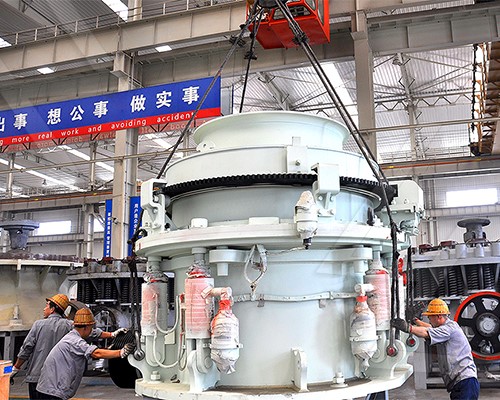
multi-cylinder hydraulic cone crusher
Core Design Principle: The Multi-Cylinder Hydraulic System
The defining feature of this crusher is its multiple hydraulic cylinders arranged around the machine’s body. Unlike single-cylinder models, these cylinders are dedicated to two separate but crucial functions: clamping force and adjustment/protection. This separation is the source of its performance benefits.
Key Performance Advantages in Fine Crushing
1. Unmatched Control Over Product Gradation and Shape
Hydraulic Adjustment Under Load: The multi-cylinder system allows for the Closed Side Setting (CSS) to be adjusted under full load and during operation. This enables real-time compensation for wear on the mantle and concave, ensuring the product size remains constant over time, which is paramount for quality control in fine crushing.
Optimized Lamination Crushing: The powerful, evenly distributed clamping force from the multiple cylinders creates ideal conditions for inter-particle crushing. Material is crushed not only between the liners but also against other rock particles under high pressure. This results in a higher percentage of cubical, well-fractured particles and a more favorable grain size distribution.
2. Exceptional Operational Stability and Efficiency
Constant Eccentric Bushing Position: The hydraulic clamping cylinders hold the main shaft and eccentric bushing in a stable, fixed position relative to the bowl. This eliminates the “lifting” motion found in single-cylinder designs, leading to a more stable main shaft and consistent crushing cavity geometry. The result is more stable power draw, higher throughput, and reduced liner wear.
Higher Speed and Stroke: Multi-cylinder crushers can be optimized with higher eccentric speeds and appropriate strokes for fine crushing applications. This combination increases the number of compression cycles per minute, improving reduction efficiency and capacity for a given size.
3. Intelligent Automation and Protection
Advanced Clearing System: In the event of an overload (e.g., tramp iron) or a sudden feed change, the hydraulic system can quickly and automatically lower the main shaft to release the chamber, then reset to the original CSS. This minimizes downtime and protects the crusher from damage.
Fully Integrated Automation (ASRi or equivalent): These crushers are typically paired with sophisticated control systems that continuously monitor pressure, power, and CSS. The system can automatically adjust operational parameters to maintain optimal performance, target product size, and protect the machine.
4. Energy Efficiency and Lower Cost per Ton
The combination of a stable crushing cavity, efficient lamination crushing, and intelligent control leads to a lower energy consumption per ton of final product compared to less advanced cone crushers in fine duty.
Longer liner life due to even wear distribution and constant CSS further reduces the operating cost (OPEX) and increases crusher availability.
Application Scenarios in Fine Crushing Circuits
High-Quality Aggregate Plants: Producing railway ballast, concrete sand (after further processing), and asphalt chips where strict shape and gradation are mandatory.
Mineral Processing: Fine crushing ahead of grinding mills (e.g., in concentrators) to achieve a finer feed size, improving overall grinding circuit efficiency (more crushing, less grinding).
Recycling: Processing demolished concrete to produce high-value, clean, cubical recycled aggregate.
Conclusion
The multi-cylinder hydraulic cone crusher is engineered to excel in the fine crushing stage, where precision, shape, and efficiency are non-negotiable. Its sophisticated design, centered on a multi-cylinder hydraulic system, provides unparalleled control over product size and shape, exceptional operational stability, and seamless integration with plant automation.
For producers aiming to maximize the yield of premium, in-spec product, minimize energy and wear costs, and achieve the highest level of process control, the multi-cylinder cone crusher represents the optimal technological choice. Its performance directly contributes to a lower total cost of ownership and a stronger competitive position in markets that demand consistent, high-quality fine aggregates.