Founded in 1987, Liming Heavy Industry specializes in the production of stationary crushers in medium and large models, mobile crushing plants, and ball mills. With over 30 years of technical experience, the company adopts advanced production technologies from the United States, Germany, Australia, and other countries. The company's professionalism and product quality are comparable to well-known international brands in the industry.
Typical Application of Jaw Crushers in Primary Crushing of Hard Stone Materials
December 5th 2025
In the mining and quarrying industries, the initial size reduction of hard stone materials such as granite, basalt, quartzite, and other high-strength aggregates presents a significant engineering challenge. This first stage, known as primary crushing, is critical for setting the foundation for downstream processing efficiency, product quality, and overall plant economics. For this demanding task, the jaw crusher has established itself as the dominant and most reliable solution worldwide. Its robust design, high breaking force, and operational simplicity make it the ideal choice for handling the toughest feeds. This article explores the typical applications, working principles, and key advantages of jaw crushers in the primary crushing of hard stone.
1. The Unmatched Role of Jaw Crushers in Hard Rock Primary Crushing
Primary crushing is defined as the first mechanical reduction stage where raw, blasted rock—often with feed sizes up to 1.5 meters—is reduced to a manageable output, typically between 150-300 mm. The operational environment is harsh, characterized by high impact loads, severe abrasion, and unpredictable feed conditions. In this context, jaw crushers excel due to their fundamental operational principle: compressive force.
1.1 Core Operating Principle
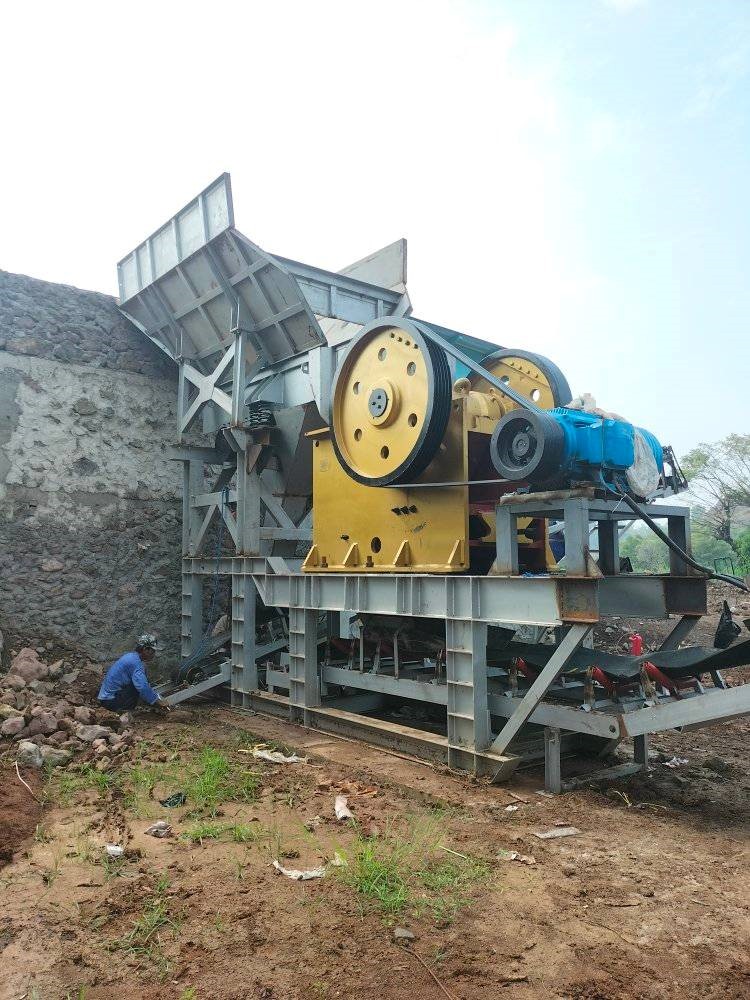
A jaw crusher consists of two vertical jaws: a fixed jaw and a moving jaw. The moving jaw, driven by an eccentric shaft, moves in an elliptical motion towards the fixed jaw. This action creates tremendous compressive force, breaking the rock by squeezing it between the two jaw plates. The crushed material then gravitates down the crushing chamber until it is small enough to escape through the discharge opening at the bottom, known as the Closed Side Setting (CSS).
jaw crusher
2. Key Design Features Suited for Hard Stone Applications
Jaw crushers designed for primary crushing of hard materials incorporate several critical features:
Heavy-Duty Frame and Components: Frames are constructed from high-quality steel plate or cast steel to withstand immense cyclical stress. Large-diameter, heavy-duty eccentric shafts and premium spherical roller bearings ensure reliable power transmission under high load.
Optimized Crushing Chamber Design: The chamber geometry, including the nip angle (the angle between the fixed and moving jaws), is engineered to maximize breaking efficiency and prevent slippage of hard, abrasive rock. A steeper nip angle provides better grip on hard materials.
High-Quality Wear Parts (Jaw Plates): Jaw plates are made from austenitic manganese steel or more advanced alloys that combine high toughness with wear resistance. Their replaceable tooth profiles are designed to apply force effectively and can often be rotated or exchanged to extend service life.
Effective Discharge Setting Adjustment: Hydraulic or mechanical shim systems allow for quick and safe adjustment of the CSS, enabling operators to control the product top size precisely and compensate for jaw plate wear.
3. Typical Application Scenarios in Hard Stone Processing
Jaw crushers are the cornerstone of primary crushing circuits in various hard rock operations:
Granite and Basalt Quarries: As the most common hard rock for high-quality aggregates, these materials require the robust compressive breaking force of a jaw crusher to produce consistent, cubical primary product.
Abrasive Mineral Mining (e.g., Iron Ore, Copper Ore): In metal mines, jaw crushers handle run-of-mine ore directly from the pit, providing a reliable first size reduction step before further processing.
Large-Scale Infrastructure Projects: For projects like dams, highways, and railways requiring massive volumes of hard stone base material, stationary or mobile jaw crusher plants are deployed on-site for primary processing.
Mobile Crushing in Mountainous Terrain: Track-mounted jaw crushers offer the flexibility to move the primary crushing unit close to the blasting face, dramatically reducing truck haulage distances and operational costs.
4. Advantages Over Alternative Technologies for Primary Crushing
Compared to gyratory crushers (the main alternative for high-tonnage primary crushing), jaw crushers offer distinct benefits in many hard rock scenarios:
Lower Installation Height and Simpler Foundation: They require less civil engineering work for installation, reducing setup time and cost, especially for stationary plants.
Easier Maintenance and Accessibility: Wear parts (jaw plates) are simpler to inspect and change. Routine maintenance tasks are generally more straightforward.
Better Suitability for Slabby Rock: The linear crushing action handles flaky or elongated pieces more effectively than other crusher types.
Flexibility in Mobile Setups: They are the preferred choice for most mobile primary crushing units due to their compact design and efficiency.
5. Guidelines for Selecting and Optimizing a Jaw Crusher
To maximize performance when crushing hard stone, consider the following:
Proper Sizing: Select a crusher with a feed opening large enough to accommodate the maximum rock size from the blast. Ensure its capacity (TPH) meets your plant’s overall design target.
Emphasize Wear Resistance: Invest in premium jaw plates specifically designed for hard, abrasive materials. Monitor wear patterns and implement a proactive replacement schedule.
Ensure Proper Feeding: Use a vibrating grizzly feeder (VGF) ahead of the crusher. This scalps out fines and ensures a steady, controlled feed rate across the full width of the jaw, which is critical for achieving optimal capacity and uniform wear.
Monitor and Adjust CSS: Regularly check and adjust the Closed Side Setting to maintain the desired product size as the jaw plates wear.
Conclusion
For the primary crushing of hard stone materials, the jaw crusher remains the most proven, reliable, and cost-effective technology. Its straightforward compressive action, combined with rugged construction and operational simplicity, provides an unmatched solution for reducing large, hard rock into a consistent product for secondary processing. By understanding its working principles and following best practices for selection, feeding, and maintenance, operators can ensure their jaw crusher delivers maximum uptime, optimal product shape, and the lowest possible cost per ton—solidifying its role as the indispensable workhorse of the hard rock crushing industry.