Founded in 1987, Liming Heavy Industry specializes in the production of stationary crushers in medium and large models, mobile crushing plants, and ball mills. With over 30 years of technical experience, the company adopts advanced production technologies from the United States, Germany, Australia, and other countries. The company's professionalism and product quality are comparable to well-known international brands in the industry.
Common Configurations of Jaw Crushers in Indonesian Stone Quarries
January 9th 2026
Indonesia’s stone quarrying sector is a vital component of its construction and infrastructure development, characterized by diverse geological conditions ranging from hard volcanic rock (andesite, basalt) to limestone and river gravel. Selecting the right equipment configuration is crucial for operational efficiency and profitability. At the heart of most primary crushing stages in these quarries sits the Jaw Crusher. Its robustness and versatility make it the undisputed first choice. This article explores the most common and effective jaw crusher configurations tailored to meet the specific demands of Indonesian quarry operations.
1. The Indonesian Quarry Context: Key Challenges and Requirements
Quarry operators in Indonesia face unique conditions that influence equipment choice:
Material Diversity: From extremely hard and abrasive volcanic rock to softer, sometimes clay-bound limestone.
Climate: High humidity, heavy rainfall, and dusty conditions.
Logistics & Infrastructure: Projects can be on remote islands or have limited on-site space.
Production Goals: Need for reliable, high-uptime equipment to produce various aggregate sizes for concrete, asphalt, and base layers.
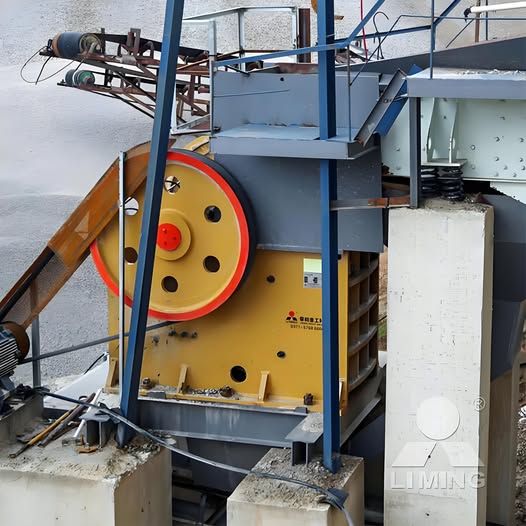
Jaw Crusher
2. Why the Jaw Crusher is the Primary Cornerstone
Before delving into configurations, it’s essential to understand why the jaw crusher is so prevalent:
High Capacity & Feed Size: Can handle large run-of-quarry boulders (often up to 800-1000mm).
Robustness & Simplicity: Excellent for hard, abrasive materials with a design that ensures high mechanical availability and easier maintenance.
Proven Technology: Operators and mechanics are familiar with its operation and upkeep.
3. Common Jaw Crusher Configurations in Indonesian Quarries
a) Standalone Primary Crushing Unit (The Classic Setup) This is the most fundamental configuration.
Components: A robust Vibrating Grizzly Feeder (VGF) followed by a Heavy-Duty Jaw Crusher.
Flow: The VGF removes natural fines (soil, small rocks) before the crusher, improving efficiency. It also regulates feed, protecting the crusher from shock loads.
Output: Crushed material (typically 0-150mm to 0-200mm) is conveyed to a separate, downstream screening and secondary crushing circuit (often with cone crushers).
Best For: Medium to large-scale stationary quarries processing hard rock, feeding a full fixed plant.
b) Integrated Primary Crushing & Pre-Screening Unit (Mobile or Semi-Mobile) A highly efficient setup to maximize capacity and reduce wear.
Components: A mobile or modular unit combining a vibrating grizzly or independent pre-screen with the jaw crusher on a single chassis.
Flow: The pre-screen removes a significant portion of fines (e.g., 0-40mm) before the jaw crusher. This “bypass” material goes directly to a product conveyor or the next stage, while only oversize goes into the crusher.
Advantage: Drastically increases effective throughput, reduces crusher wear and power consumption, and prevents chamber packing with sticky material—a key benefit in humid climates.
Best For: Quarries with material containing high fines or clay, and for operations prioritizing fuel and wear-part economy.
c) Mobile Jaw Crusher as the Core of a Compact Line Ideal for smaller, remote, or multiple-site projects.
Components: A track-mounted or wheeled mobile jaw crusher, sometimes coupled directly with a mobile cone crusher and screen.
Flow: The mobile jaw performs primary crushing on-site. The crushed material can be fed directly into a mobile secondary cone and screening unit in series.
Advantage:Eliminates trucking of raw material, offers extreme flexibility, and allows quick relocation. Perfect for contract crushing or developing new quarry sites with uncertain long-term reserves.
Best For: Satellite quarries, infrastructure projects (e.g., toll road segments), and operators needing maximum logistical flexibility.
d) Heavy-Duty Jaw for High-Abrasion Rock (Volcanic Rock Focus) A specification-focused configuration for Indonesia’s toughest materials.
Key Feature: The jaw crusher itself is selected and equipped for extreme duty.
Heavier frame and components.
Optimal jaw die metallurgy (e.g., premium manganese steel) and tooth profile for breaking abrasive andesite/basalt.
Large, accessible grease banks for easy maintenance of bearings in dusty conditions.
Supporting Setup: Often paired with a very robust apron feeder instead of a VGF to handle sharp, blocky volcanic rock.
4. Fixed Plant vs. Mobile/Semi-Mobile Configuration
The choice depends on project scale and duration:
Fixed Plant (with stationary jaw): Higher ultimate capacity, lower long-term operating cost per ton. Best for large, long-life (>5-7 years) quarries with a central location.
Mobile/Semi-Mobile Jaw: Lower capital commitment, faster setup, and unparalleled mobility. Provides the best return on investment for short to medium-term projects or quarries with multiple faces.
Conclusion: Building a Productive Foundation
The configuration of the jaw crusher in an Indonesian stone quarry is the foundational decision that dictates the efficiency of the entire downstream process. There is no one-size-fits-all answer. The optimal choice balances the hardness and abrasiveness of the local stone, the required production volume, the project’s logistical constraints, and the investment horizon.
Whether it’s a high-capacity fixed plant with integrated pre-screening for a large limestone operation or a nimble track-mounted unit tackling volcanic rock on a remote island, the jaw crusher remains the reliable, powerful workhorse. By selecting the right model and surrounding it with the optimal feeder and pre-screening configuration, Indonesian quarry operators can ensure a stable, high-output primary stage that maximizes material yield and minimizes operating costs, laying a solid foundation for a profitable operation.