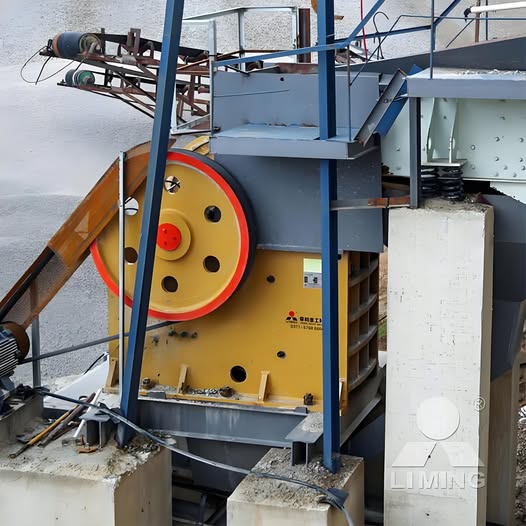
Founded in 1987, Liming Heavy Industry specializes in the production of stationary crushers in medium and large models, mobile crushing plants, and ball mills. With over 30 years of technical experience, the company adopts advanced production technologies from the United States, Germany, Australia, and other countries. The company's professionalism and product quality are comparable to well-known international brands in the industry.
The Adaptability of Jaw Crushers to Irregular Rock Blocks
January 13th 2026
In the demanding worlds of mining, quarrying, and demolition, the primary crushing stage must handle whatever the shovel or blast provides. Feed material is rarely uniform; it consists of irregular rock blocks—angular, slabby, and of wildly varying sizes. The success of the entire crushing circuit hinges on the first machine’s ability to cope with this challenge. The Jaw Crusher, with its straightforward yet profoundly robust design, possesses an exceptional and inherent adaptability to irregular feed, making it the undisputed champion of the primary crushing station.
The Challenge of Irregular Feed
Irregular blocks pose specific problems for crushing equipment:
Bridging: Arched blocks can jam over a feed opening.
Uneven Wear: Slabby material can cause asymmetric loading, leading to accelerated and uneven wear on crushing surfaces.
Shock Loads: Large, angular blocks dropping into the chamber create significant impact forces.
Size Variation: The machine must handle both large and small pieces efficiently without choking.
Jaw Crushers
How Jaw Crusher Design Masters Irregularity
The jaw crusher’s adaptability is not accidental; it is engineered into its core principles.
1. The V-Shaped Chamber: A Natural Funnel The crushing chamber is formed by a fixed jaw and a reciprocating movable jaw, creating a tapered “V” shape from top to bottom. This geometry is perfect for irregular blocks.
Guides Material Downward: Regardless of the block’s shape or orientation as it enters, the sloping walls of the chamber naturally guide it toward the narrow discharge point (the closed-side setting).
Progressive Crushing: A large, angular block is gripped at its top and crushed incrementally as it travels down the chamber, breaking into smaller pieces that are further reduced.
2. Massive Robustness and High Inertia Jaw crushers are built with incredibly heavy frames, large-diameter eccentric shafts, and substantial flywheels.
Handles Shock Loads: The mass and inertia of the moving parts allow the crusher to absorb the tremendous impact forces from large, irregular blocks without stalling.
Continuous Power: The flywheels store energy on the return stroke of the jaw and deliver it during the crushing stroke, ensuring a powerful, consistent crushing action even with uneven feed.
3. No “Sweet Spot” Required Unlike some crushers that require optimal feed orientation, a jaw crusher does not rely on the rock striking a precise point. Its compressive crushing action works wherever the jaws make contact with the block. An irregular shape will simply be gripped at its protruding points and fractured.
4. Relatively Insensitive to Fines and Damp Material While not ideal, jaw crushers can tolerate a certain amount of dirt, fines, or moisture in the feed—conditions often present with irregular, run-of-quarry or demolition material—better than cone crushers, which are more prone to packing and choking under such conditions.
Operational Advantages Stemming from This Adaptability
Reduced Pre-processing: Less time and effort are needed to pre-sort or break down extremely irregular feed before the primary crusher.
High Uptime: The simple, robust mechanism is less likely to jam or suffer catastrophic failure from an awkwardly shaped block, especially when protected by modern hydraulic toggle release systems.
Versatility Across Applications: This same adaptability makes it ideal not just for virgin rock quarries but also for recycling demolition concrete and reinforced concrete, which is inherently irregular and heterogeneous.
Comparison with Other Primary Crusher Types
Gyratory Crushers: Highly capable for high-tonnage, uniform feed but generally require more consistent sizing and can be more sensitive to slabby material that might cause uneven wear in the mantle.
Primary Impact Crushers: Can handle irregularity but are often better suited for less abrasive materials. The direct impact on irregular, very hard rock can lead to higher wear costs on hammers and aprons compared to the compressive wear in a jaw.
Optimizing Performance with Irregular Feed
To maximize the jaw crusher’s natural advantages:
Use a Vibrating Grizzly Feeder (VGF): This is highly recommended. It scalps out fine material that can cushion crushing and helps present a more even flow of irregular blocks to the crusher, leveling out load demand.
Proper Jaw Die Selection: Choose the correct jaw die profile (e.g., corrugated, straight, or hybrid) for the application to optimize grip and breakage efficiency on angular rock.
Monitor and Maintain: Regularly check wear patterns on jaw dies. Asymmetric wear can be a sign of consistently uneven feeding of slabby material, which may require corrective action at the feeder.
Conclusion: The Unmatched First Line of Defense
The jaw crusher’s adaptability to irregular rock blocks is a fundamental reason for its enduring dominance in primary crushing. Its V-shaped chamber, brute-force mechanics, and tolerance for unpredictable feed allow it to act as a reliable, low-friction gateway for the most challenging run-of-mine and demolition materials.
For operators facing variable geology or processing demolition waste, the jaw crusher provides the confidence and reliability needed to keep the circuit running. It doesn’t just crush rock; it tames the chaos of irregular feed, providing a stable, manageable product for the downstream stages. This inherent capability solidifies its role as the indispensable, adaptive workhorse at the heart of material reduction.