Founded in 1987, Liming Heavy Industry specializes in the production of stationary crushers in medium and large models, mobile crushing plants, and ball mills. With over 30 years of technical experience, the company adopts advanced production technologies from the United States, Germany, Australia, and other countries. The company's professionalism and product quality are comparable to well-known international brands in the industry.
Adaptability of Tracked Crushing Plants to Complex Terrain
December 1st 2025
Construction, mining, and quarrying projects are increasingly pushing into challenging landscapes—remote mountains, dense forests, soft wetlands, and rugged, uneven ground. In these environments, traditional wheeled equipment or fixed plants are often impractical or prohibitively expensive to deploy. Tracked crushing plants are engineered specifically to overcome these barriers, offering unparalleled adaptability and opening new possibilities for material processing in the world’s most demanding locations.
Superior Traction and Mobility on Unstable Ground
The core advantage of a tracked chassis is its ability to maintain traction and stability where wheels would fail.
Low Ground Pressure: The large surface area of the tracks distributes the plant’s weight evenly, allowing it to operate on soft, muddy, or sandy ground without sinking or causing excessive rutting.
Powerful Crawler Drive: Individually powered tracks provide exceptional grip and precise maneuverability on steep slopes (often up to 25-30 degrees), loose gravel, and rocky outcrops.
Independent Track Control: Operators can counter-rotate the tracks for zero-radius, on-the-spot turning, enabling navigation in extremely tight spaces common in confined quarries or winding mountain sites.
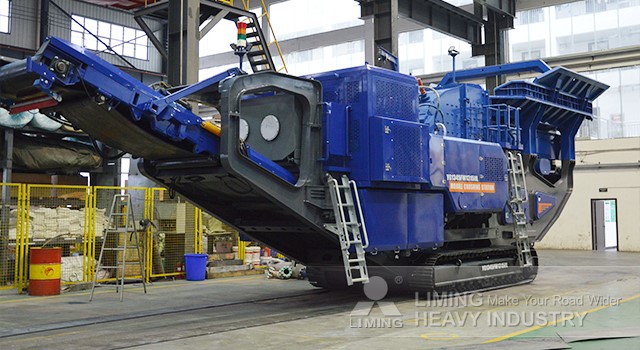
Tracked crushing plants
On-Site Versatility and Elimination of Haulage
Tracked plants bring the processing hub directly to the material source, revolutionizing logistics in difficult terrain.
Follow the Resource: The plant can be driven directly to the rock face in a quarry or along the winding path of a linear project like a pipeline or mountain road, processing material where it lies.
Eliminate Truck Haulage: By crushing in-situ, the need for expensive and dangerous truck haulage of raw material over rough, steep access roads is drastically reduced or eliminated.
Rapid Relocation: The self-propelled nature allows the plant to be moved between multiple small pits or different sections of a large site quickly, maximizing asset utilization.
Autonomous Operation and Reduced Infrastructure Dependence
These plants are designed for independence, a critical factor in remote or undeveloped areas.
Self-Contained Power: Most are equipped with robust onboard diesel-electric power packs, eliminating the need for an external electricity grid.
Minimal Site Preparation: Unlike fixed plants requiring deep foundations, tracked units need only a reasonably level and stable platform. They can often start working within hours of arrival.
Integrated Process: Modern tracked plants are complete systems, integrating a feeder, crusher (often an impactor or jaw), and screen on a single chassis, delivering sized product directly from the machine.
Durability and Reliability in Harsh Conditions
Built for the toughest environments, tracked crushing plants are engineered to withstand constant stress.
Reinforced Undercarriage: Heavy-duty tracks, rollers, and idlers are built to endure the abrasive wear of rock dust and the impacts of uneven ground.
Protected Components: Critical systems (hydraulics, conveyors, engines) are often housed within the chassis or have protective guarding against falling debris and weather.
All-Weather Capability: Sealed and hardened components ensure reliable operation in rain, dust, heat, and cold.
Conclusion: Unlocking Inaccessible Resources
In summary, the adaptability of tracked crushing plants to complex terrain is their defining feature. They transform logistical nightmares into manageable operations by providing all-terrain mobility, self-sufficient power, and on-the-spot processing. For projects in mountainous regions, soft-ground sites, or any location where access is a primary constraint, a tracked crushing plant is not just an option—it is the essential key to unlocking resources, controlling costs, and executing projects that would otherwise be unviable.