Founded in 1987, Liming Heavy Industry specializes in the production of stationary crushers in medium and large models, mobile crushing plants, and ball mills. With over 30 years of technical experience, the company adopts advanced production technologies from the United States, Germany, Australia, and other countries. The company's professionalism and product quality are comparable to well-known international brands in the industry.
Selecting a Mobile Crusher for Construction Sand Production Line
October 31st 2025
The demand for high-quality construction sand is constantly growing, driven by global infrastructure development. Traditional stationary sand plants, while effective, lack the flexibility and on-site processing capabilities required for many modern projects. The mobile crusher has emerged as a revolutionary solution, enabling efficient and cost-effective sand production directly at the source. This guide explores the key factors in selecting a mobile crusher for a construction sand production line.
Key Advantages of a Mobile Crusher for Sand Production
Before selecting a specific model, it’s crucial to understand the core benefits a mobile setup provides:
On-Site Processing: Crush raw materials (river pebbles, limestone, granite, or construction waste) directly at the quarry or demolition site, drastically reducing transportation costs.
Rapid Deployment and Flexibility: Set up and begin production in hours, not weeks. Easily relocate the entire plant between different project sites or as the quarry face advances.
Compact Footprint: Operates in confined spaces where a stationary plant would be impractical.
Integrated Process: Modern mobile plants often combine crushing and screening in a single, highly automated unit.
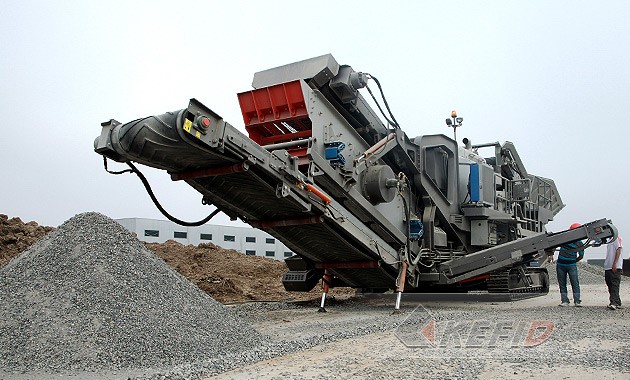
mobile crusher
How to Choose the Right Mobile Crusher
Selecting the optimal mobile crusher depends on a careful analysis of your specific needs. Consider the following factors:
1. Feed Material Characteristics
Hardness and Abrasiveness: Is it soft limestone or hard, abrasive granite? This is the most critical factor.
Size and Gradation: What is the maximum feed size?
Moisture and Clay Content: Sticky materials can cause clogging in certain crushers.
2. Desired Final Product
Grain Shape: Do you require perfectly cubical sand for high-strength concrete?
Gradation: What specific sand sizes (e.g., 0-3mm, 0-5mm) are needed to meet market or project specifications?
3. Required Capacity (Tons Per Hour)
Determine your production targets to select a crusher with adequate power and throughput.
4. Power Source
Diesel: Offers complete independence and is ideal for remote sites.
Electric: Lower operating costs and quieter operation, but requires a grid connection.
Types of Mobile Crushers for Sand Production
Different crushers are suited for different stages and materials in the sand-making process.
1. Mobile Jaw Crusher (Primary Crushing)
Role: The first link in the chain. It takes large raw feed and reduces it to a manageable size (e.g., 0-150mm).
Best for: Processing the initial, large-sized rock before it is sent to the sand-making unit.
2. Mobile Cone Crusher (Secondary Crushing)
Role: Ideal for intermediate crushing of hard and abrasive rocks. It produces a well-shaped product but is less effective at creating the fine particles needed for sand.
Best for: Producing high-quality coarse aggregates and preparing hard rock for the final sand-making stage.
3. Mobile Impact Crusher (Secondary/Tertiary Crushing)
Role: Excellent for less abrasive materials like limestone. It produces a very cubical product and offers a high reduction ratio.
Best for: One-step crushing to produce a well-shaped aggregate and some sand fractions. However, wear costs can be high on abrasive rock.
4. Mobile Vertical Shaft Impact (VSI) Crusher (The Sand Maker)
Role: This is the most important machine specifically for sand production. It uses a “rock-on-rock” or “rock-on-iron” crushing principle to shape and refine particles into high-quality, cubical sand.
Best for: The final stage of sand manufacturing. It is unparalleled in optimizing grain shape and controlling the final sand gradation.
Recommended Configuration for a Sand Production Line
The most effective setup for a high-quality sand product is a multi-stage mobile plant:
Mobile Jaw Crusher + Mobile Cone Crusher + Mobile VSI Crusher: This is the optimal combination for hard, abrasive rock (e.g., granite, basalt). The jaw crusher does the primary crushing, the cone crusher provides a well-graded feed for the VSI, and the VSI crusher produces the final, high-quality sand.
Mobile Jaw Crusher + Mobile VSI Crusher: A simpler, cost-effective setup for medium-hard rock where the primary crushed material can be fed directly into the VSI.
Conclusion
Selecting a mobile crusher for a construction sand production line requires a strategic approach focused on your raw material and final product goals. For the best results, prioritize a configuration that includes a Mobile VSI Crusher as the core sand-making unit, supported by primary and secondary crushers tailored to your rock’s hardness. By investing in the right mobile technology, you can achieve unparalleled flexibility, significantly lower operating costs, and produce premium sand that meets the stringent demands of the modern construction industry.