Founded in 1987, Liming Heavy Industry specializes in the production of stationary crushers in medium and large models, mobile crushing plants, and ball mills. With over 30 years of technical experience, the company adopts advanced production technologies from the United States, Germany, Australia, and other countries. The company's professionalism and product quality are comparable to well-known international brands in the industry.
Advantages of Impact Crushers in the Fine Crushing of Limestone
December 11th 2025
Within the aggregates and building materials industries, limestone stands as one of the most processed raw materials globally. The final stage of its size reduction—fine crushing—is critical for producing high-value end products like manufactured sand (artificial sand), concrete sand, asphalt chips, and agricultural lime. For this specific task, the impact crusher (or horizontal shaft impactor) demonstrates a distinct and compelling set of advantages over other types of crushing equipment. Its operational principles align exceptionally well with the physical characteristics of limestone, making it a preferred choice for efficient, high-quality, and economical fine crushing. This article details the key technological and economic advantages of using impact crushers for limestone fine crushing.
Ideal Material-Technology Match: Why Limestone and Impact Crushing are Synergistic
Limestone’s material properties make it perfectly suited for impact crushing:
Medium to Low Hardness & High Brittleness: Limestone typically has a compressive strength well within the optimal range for impact breakage. It fractures readily along natural bedding planes when struck.
Low to Moderate Abrasiveness: Compared to igneous rocks like granite, limestone is far less abrasive. This drastically reduces the wear rate on the crusher’s consumable parts (blow bars, impact plates), a primary operational cost.
Demand for Superior Particle Shape: Many limestone products, especially sand for concrete and asphalt, require cubical, angular particles for optimal performance. This is precisely what impact crushers are engineered to produce.
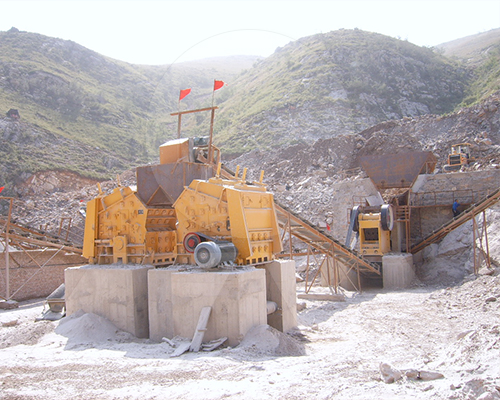
impact crusher
Core Advantages of Impact Crushers in Limestone Fine Crushing
1. Exceptional Particle Shape and Gradation Control This is the most significant advantage for product quality.
Principle of Impact & Attrition: Material is accelerated by the high-speed rotor and shattered against impact aprons or within the rock-on-rock crushing chamber. This combined action of direct impact and inter-particle attrition naturally produces a high percentage of cubical, fractured particles with clean, sharp edges.
High-Quality Manufactured Sand: This makes impact crushers ideal for producing limestone sand (artificial sand) with excellent properties for concrete, including reduced water demand and improved workability and strength.
Adjustable Parameters: The final product’s gradation can be precisely controlled by adjusting rotor speed, the gap between blow bars and impact aprons, and the configuration of the grinding path. This allows for flexible production to meet different specifications.
2. High Reduction Ratio and Production Efficiency in a Single Stage
Impact crushers can achieve very high reduction ratios (often exceeding 20:1) in a single pass. This allows feed material from a secondary cone crusher (e.g., ~40mm) to be reduced directly to fine sand or chips (e.g., 0-5mm, 5-10mm) efficiently, potentially simplifying the overall crushing circuit.
Closed-Circuit Configuration: When equipped with a recirculating screen, an impact crusher operates in a closed circuit. Oversize material is returned for further crushing, ensuring precise control over the top size and maximizing the yield of in-spec product—ideal for high-value sand production.
3. Lower Operating Costs and Ease of Maintenance
Energy Efficiency: For processing non-abrasive materials like limestone, impact crushers generally offer a lower energy consumption per ton of final product compared to cone crushers performing a similar fine-crushing duty.
Wear Part Management: Although wear occurs, the blow bars and impact aprons are designed for easy and relatively quick replacement or rotation. Their cost, for limestone applications, is typically manageable and predictable, leading to a favorable cost-per-ton for wear parts.
Accessibility: Modern designs feature hydraulic opening systems for safe and fast access to the crushing chamber for inspection and maintenance.
4. Flexibility and Versatility
Multi-Product Capability: A single impact crusher, through adjustments and with the aid of a screen, can produce a range of fine products from a single feed source—e.g., concrete sand, asphalt sand, and agricultural lime filler.
Moisture Tolerance: Impact crushers generally handle limestone with moderate moisture content better than cone crushers, which are more prone to packing and clogging with sticky fines.
Conclusion: The Optimal Choice for High-Value Fine Products
For the fine crushing of limestone, the impact crusher’s advantages are decisive where product shape, production efficiency, and operational cost are primary concerns. Its ability to generate a superior, cubical product directly translates into higher-value sand and aggregates that meet stringent specifications for modern construction materials.
When the production goal is premium manufactured sand for concrete or asphalt, or tightly graded chips with excellent physical properties, the impact crusher offers a technologically and economically superior solution. Its efficiency, flexibility, and favorable cost structure make it the preferred workhorse for limestone processors aiming to maximize the quality and profitability of their fine aggregate products.
Looking to optimize your limestone fine crushing circuit for better sand production? Consult with our crushing experts to analyze your specific feed material and product goals, and determine the ideal impact crusher configuration for your operation.