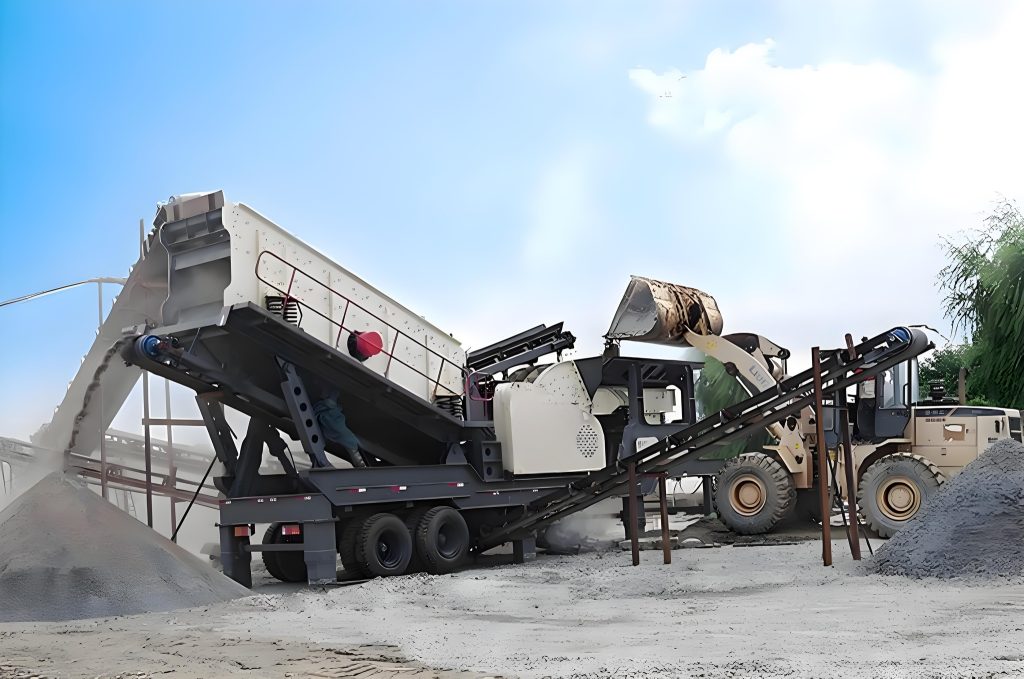
Founded in 1987, Liming Heavy Industry specializes in the production of stationary crushers in medium and large models, mobile crushing plants, and ball mills. With over 30 years of technical experience, the company adopts advanced production technologies from the United States, Germany, Australia, and other countries. The company's professionalism and product quality are comparable to well-known international brands in the industry.
Mobile Crusher with Screening System for Aggregate Production
August 7th 2026
Based on our recent plant audits in high-silica river gravel circuits, the primary cause of poor capital payback velocity isn’t the upfront equipment price of the Mobile Crusher with Screening System for Aggregate Production, but the hidden chaos of unbalanced material flow dynamics. Engineers frequently fail to match primary reduction ratios with secondary screen deck stratification thresholds. This operational mismatch chokes the secondary chamber with oversized recirculating loads, causing severe mechanical friction, unmanageable flakiness indexes, and rapid motor degradation.
Synchronizing Closed-Circuit Material Flow Balance
Achieving equilibrium across a multi-stage mobile circuit requires strict synchronization between the primary jaw’s discharge curve and the secondary screen’s maximum acceptance threshold.
When oversize material constantly bypasses secondary reduction, the closed-circuit return loops accumulate uncrushed hard rock. Plant managers must calculate the exact recirculating load ratio based on closed-side setting (CSS) adjustments and real-time screen deck efficiency. Pushing material bed depths beyond three times the maximum mesh aperture destroys the acceleration energy across the screen surface. Fines carry over into the coarse aggregate stockpiles, corrupting product specifications and destroying the production-to-cost ratio.
Controlling Particle Shape and Flakiness Index
Infrastructure concrete specifications mandate rigid limits on elongated particles, forcing circuits to leverage inter-particle attrition within choked-feed cone crushing zones.
Inter-particle attrition forces rock fragments to fracture along natural grain boundaries rather than artificial shear lines. Deploying a continuous quality filter directly behind the secondary crusher guarantees high-cubicity aggregate. Material rejected by the top screen deck recirculates at a strictly controlled rate. Maintaining a consistent 20% to 30% recirculating load ensures that elongated slabs undergo secondary re-crushing. The physical geometry of the discharge setting must be engineered in tandem with the wire aperture sizing to stop oversized flakes from infiltrating finished batches.
Operating sizing systems in high-moisture clay environments forces wet fines to adhere to wire apertures, forming a solid crust that severely degrades open screening area.
This physical blockage triggers massive, artificial recirculating loads. The unbalanced recirculating load balancing overworks drive motors and strips conveyor belt edges in a matter of weeks. Engineers must counteract mesh blinding by deploying anti-clogging polyurethane decks combined with optimized throw angles locked between 18 and 22 degrees. Maintaining a strict 1:1.2 transfer capacity margin on the return conveyors acts as an essential buffer during unexpected density surges, securing long-term operational viability.
To handle the abrasive variables of multi-stage aggregate sizing at 300 tons per hour, we have engineered the following circuit matrix based on current field data.
Process Stage
Recommended Model
Capacity (tons per hour)
Power (kilowatts)
Max Feed (millimeters)
Mounting Type
Primary Mobile Scalping & Crushing
NK75J
150-350
141.4
680
Pneumatic/Tire-mounted
Secondary Shaping & Screening (Closed Loop)
NK300H (Screening with return material)
110-440
323.5
220
Pneumatic/Tire-mounted
Medium Rock Secondary Impact & Screening
NK1213 (Screening with return material)
150-300
272
300
Pneumatic/Tire-mounted
Compact Tracked Secondary Cone Circuit
MK300HS
A+(30~70)
250
220
Track-mounted
Field Wear Benchmarks: Synchronizing HPT300 with Abrasive Granite
Motor Draw: 323.5 kilowatts (NK300H Configuration)
Recirculating Load Target: 20% to 30%
Maximum Particle Intake: 220 millimeters
Discharge Fraction Tolerance: Strict flakiness index monitoring
Peak Tonnage Limit: 440 tons per hour
Technical Index: LH-MOBILE CRUSHER WITH SCREENING SYSTEM FOR AGGREGATE PRODUCTION-August/2026-Ref-#48291
Site Architect’s Log: Eliminating Mesh Blinding in High-Moisture Granite Operations
Why does the return conveyor motor overheat exclusively when processing wet feed? The damp fines create a sticky industrial paste that blinds the lower screen decks immediately. This prevents the -20mm material from falling through, forcing thousands of tons of acceptable product back up the return loop, overwhelming the motor’s amperage limit. How does adjusting the secondary cone closed-side setting influence flakiness? Compared to old open-circuit methods, tightening the setting forces a denser choke feed. This creates immense inter-particle pressure (exceeding 200 MPa of compressive force), cracking the rock into uniform, cubical shapes rather than flat shards. Stop ignoring the stroke amplitude on your screening decks; what is the proper calibration? Drive eccentric counterweights must be tuned to generate between 4.5g and 5.2g of acceleration. Anything less will fail to fluidize the deep material bed required for 300 tons per hour, trapping fines on top of the mesh. Our data shows a 35% recirculating load on the NK300H circuit; is this acceptable? That physical geometry is highly inefficient. Pushing past the 30% boundary indicates the primary jaw is discharging slabs too large for the cone to process in a single pass, hemorrhaging your expenditure per shift.
Secure Your 800tph Infrastructure Fiscal Viability
“Stop guessing on stroke amplitude and recirculating load dynamics.” — From the Desk of your Solution Architect