Founded in 1987, Liming Heavy Industry specializes in the production of stationary crushers in medium and large models, mobile crushing plants, and ball mills. With over 30 years of technical experience, the company adopts advanced production technologies from the United States, Germany, Australia, and other countries. The company's professionalism and product quality are comparable to well-known international brands in the industry.
80TPH Mobile Crushing Plant for Small Quarry Operations
August 4th 2026
Based on our recent field tests in expanding regional aggregate sites, the biggest threat to capital payback velocity is not the upfront equipment price of the machinery. The true profit killer is the hidden 30-day bleed of civil engineering and site preparation. Pouring concrete foundations means waiting, and waiting means zero cash flow. When assessing small pit requirements, operators demand immediate discharge. Transitioning to a foundation-free chassis changes the entire financial timeline.
Bypassing the 30-Day Concrete Bottleneck
Transitioning to a foundation-free chassis instantly reclaims one month of lost production.
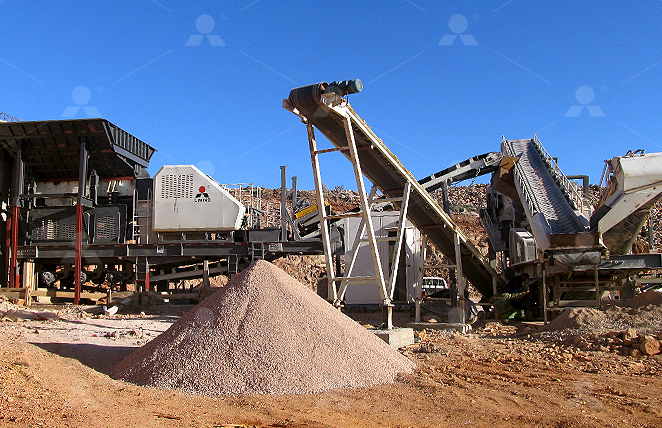
Stationary setups require extensive surveying, excavation, rebar placement, and concrete curing. The K3/NK series mobile architecture eliminates this entirely. The integrated high-capacity secondary cone crusher systems distribute their load across a rigid steel frame directly onto leveled dirt. You drive the unit into the pit, unfold the integrated belt conveyors, and start crushing rock. The smell of curing concrete is replaced by the immediate dust of profitable aggregate generation.
Vibration is managed through heavy-duty hydraulic support legs rather than concrete anchors. Operators literally feel the steady hum of a 45-ton chassis stabilizing itself on raw terrain, completely bypassing local permit delays associated with permanent structures.
Figure 1: K3T100-4 Integrated Mobile Crushing Plant eliminating civil engineering requirements on a remote quarry site.
Synchronized Equipment Matrix for Compact Pits
To handle variable geology at a consistent 80 tons per hour, we engineered the following configuration. This layout prioritizes continuous material flow and minimizes expenditure per shift.
Process Stage
Recommended Model
Capacity (tons per hour)
Power (kilowatts)
Max Feed (millimeters)
Primary Mobile Crushing
K3T100-4 [cite: 316]
70-120 [cite: 316]
130 [cite: 316]
430 [cite: 316]
Material Transfer
B6X-Width-500 [cite: 322]
150 [cite: 322]
4 [cite: 322]
N/A
The 70-120 tons per hour operational flexibility ensures that even if loader feed rates fluctuate, the crusher maintains steady output without choking[cite: 316].
Optimizing the 430mm Intake Threshold
Starving the primary chamber spikes your expenditure per shift instantly.
When running a compact multi-stage granite crushing circuit, continuous feeding is non-negotiable. The 130 kilowatt drive system [cite: 316] demands a steady material flow. We routinely observe operators losing 15% efficiency because their wheel loaders cannot match the intake rhythm of the vibrating feeder. You must match your blasting profiles to the 430mm max feed specification[cite: 316].
Oversized boulders require secondary breaker intervention, halting the main conveyor line. Maintaining strict fragmentation control before material hits the hopper ensures the eccentric shafts operate within their designed stress thresholds, preventing localized overheating on the main bearings.
Field Outpt Benchmarks: Synchronizing K3T100-4 with Volatile Loader Rates
Integrated System Weight: 45 Tons [cite: 316]
Main Drive Power: 130 Kilowatts [cite: 316]
Rated Output Range: 70-120 tons per hour [cite: 316]
Why does the 130 kW motor amperage spike during initial cold starts without a foundation? Look at the hydraulic leveling legs first. If the chassis isn’t perfectly level on the raw dirt, rotational torque from the heavy eccentric shaft fights gravity unevenly, forcing the 130 kilowatt motor to draw excessive current to overcome the mechanical imbalance. How do we control discharge stockpile limits in tight quarry spaces? Track the operational footprint physically. The folding belt conveyors allow you to direct the 70-120 tons per hour output away from the loader path, but you must assign a dedicated wheel loader to clear the discharge zone every 45 minutes to prevent belt rubbing. Can the K3T100-4 handle sudden inclusions of high-moisture clay? Do not ignore material screening. Wet clay acts like an industrial paste inside the crushing chamber. While the equipment processes 430mm dry rock easily, sticky clay will bridge across the toggle plates, dropping your production-to-cost ratio to zero until manually cleared. What is the actual setup time from flatbed trailer to first crushed rock? Based on recent timed deployments, a skilled crew can unfold the conveyors, connect external power to the 130 kilowatt drive, and initialize the control panel in under 4 hours. No concrete means no waiting.
Enforcing Rapid Asset Amortization in Compact Quarries
Your competitors who deployed mobile units will have already shipped 15,000 tons of material while your stationary plant is still waiting for local concrete inspections. Relying on civil engineering for a 70-120 tons per hour operation introduces an unacceptable lag in your capital payback velocity. If you fail to utilize foundation-free chassis designs, the continuous drain of site preparation costs will completely neutralize the profit margin of your first six months of operation. Shift to mobile architecture immediately to stop the financial bleeding.
Stop Guessing on Site Deployment Delays
“Assess exactly how many production days you lose to concrete curing.” — From the Desk of your Lead Production Efficiency Architect