Founded in 1987, Liming Heavy Industry specializes in the production of stationary crushers in medium and large models, mobile crushing plants, and ball mills. With over 30 years of technical experience, the company adopts advanced production technologies from the United States, Germany, Australia, and other countries. The company's professionalism and product quality are comparable to well-known international brands in the industry.
PE900x1200 Jaw Crusher for Large Scale Stone Crushing Plant
July 29th 2026
Based on 500 hours of recent risk audits in abrasive basalt and granite circuits, the ultimate threat to operational viability isn’t the initial equipment investment—it’s the catastrophic halt caused by a primary frame fracture. When a dense 750mm boulder drops into the crushing cavity, the resulting stress waves mercilessly expose any flaw in the structural integrity. The primary station is the sole gatekeeper for the entire downstream operation. A compromised unit does not just stop production; it initiates an aggressive financial hemorrhage across the entire plant schedule.
Mitigating Kinetic Stalls Under 750mm Feed Loads
Heavy-duty flywheel inertia directly dictates continuous crushing force and prevents fatal motor stalling during peak load spikes.
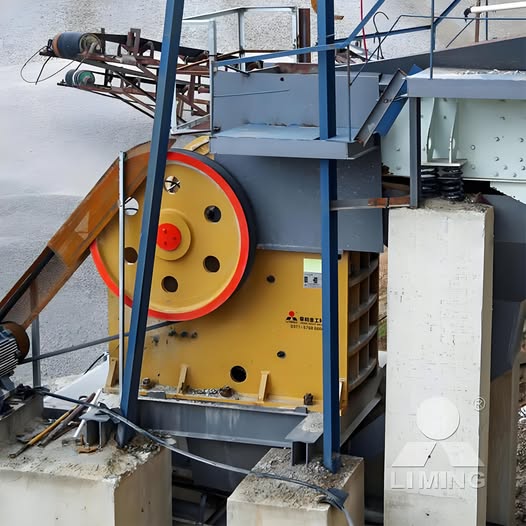
The kinetic energy stored in the dual cast-iron flywheels ensures the 132kW motor is not solely bearing the brute force of a massive rock feed. We consistently see cheap primary units stall out because they lack the sheer rotational mass required to punch through high-density ore. The physics demand momentum. When operating at peak loads approaching 380 tons per hour, a drop in rotational velocity instantly bridges the jaw cavity. The auditory warning is distinct: a dropping, groaning frequency from the V-belts right before the eccentric shaft seizes. You must evaluate the flywheel balancing protocols to ensure kinetic energy is efficiently translated into crushing force without transferring destructive vibrations back into the foundation.
Defending the Eccentric Shaft and Pitman Assembly
Eccentric shaft micro-fractures remain the highest hidden liability in high-tonnage primary operations.
The stress applied to the swing jaws during the compression cycle transfers directly to the eccentric shaft and its main bearings. The invisible leak of secondary maintenance overhead usually begins precisely here. If the metallurgical composition of the main shaft cannot endure repeated 200MPa compression events, heat-discoloration will quickly appear around the bearing housings. Look closely at the toggle plate geometry. It acts as the final mechanical fuse for the entire machine. A well-engineered toggle plate snaps under uncrushable stress, immediately severing the drive link to protect the core pitman from fatal destruction. Operating without factory-certified toggle plates is equivalent to bypassing a high-voltage circuit breaker.
Robotic welding processes eliminate the microscopic fatigue points that plague manual fabrications after 10,000 hours of continuous vibration.
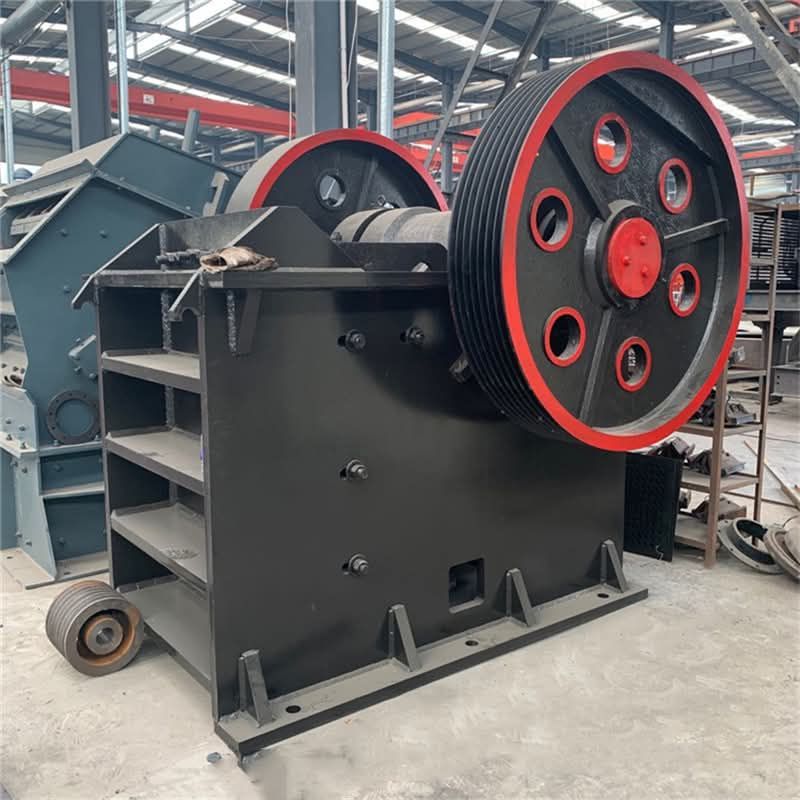
The capital payback velocity of this primary unit depends entirely on the heavy-duty main frame surviving years of relentless cyclic loading. You cannot patch a cracked frame in the field and expect it to hold geometric tolerances. Our engineers observed that stress-relieved frames—heated in specialized ovens to remove manufacturing tensions—absorb the kinetic shock of a full rock chamber without developing hairline fissures. If you rely on sub-standard frame plates, prepare for a zero-unplanned-downtime policy to shatter within the first fiscal quarter. The volatility patterns in regional electricity costs will pale in comparison to a six-day emergency shutdown waiting for a specialized heavy-welding crew to arrive on site.
Figure 2: PE900x1200 Main Frame – Microscopic Weld Fatigue Analysis
Site Audit Ledger: 380tph Primary Circuit Baselines
Investor Audit: Uncovering the Hidden Risks of Primary Frame Failure
Why does the main bearing temperature spike above 65°C during continuous 380 tph feeding? In high-altitude operations across the Andes, we track this directly to inadequate grease purging frequencies. The 132kW motor is pushing the eccentric shaft to its absolute limit, and contaminated lubrication creates friction thermal traps that destroy the bearing races. How does the toggle plate prevent catastrophic pitman destruction? Historical site data proves that non-compressible foreign objects, like a broken loader tooth, will instantly halt the swing jaw. The cast toggle plate is mathematically calculated to shatter at a specific tensile load, instantly severing the kinetic connection and saving the massive primary frame. What is the exact fiscal consequence of ignoring daily tension rod inspections? Stop guessing on tension spring intervals. A loose tension rod allows the swing jaw to float loosely during the retraction cycle, causing intense impact hammering against the toggle seat. This micro-collision ruins the entire toggle block within 72 hours, resulting in massive expenditure per shift. Can we push an 800mm boulder into the cavity if it technically fits the upper lip? Physical crushing physics dictate an absolute maximum feed of 750mm to maintain the necessary grip angle between the jaw plates. Exceeding this boundary creates a “bridging” effect, stalling production entirely and requiring dangerous, time-consuming manual clearing by the pit crew.
Enforcing Structural Survival in High-Tonnage Circuits
The mechanical reality of fracturing 750mm rock at continuous peak capacities requires uncompromising mass, heavy-duty frame integrity, and flawless kinetic stability. Relying on inferior frame casting or underweight flywheels guarantees a catastrophic mechanical seizure next month, completely paralyzing your entire downstream production infrastructure. Demand absolute structural verification and kinetic consistency before authorizing any primary crushing capital deployment.
Secure Your Primary Infrastructure Viability
“Do not leave your plant’s survival to chance. Let us audit your primary crushing stresses.” — From the Desk of your Risk Auditor