Founded in 1987, Liming Heavy Industry specializes in the production of stationary crushers in medium and large models, mobile crushing plants, and ball mills. With over 30 years of technical experience, the company adopts advanced production technologies from the United States, Germany, Australia, and other countries. The company's professionalism and product quality are comparable to well-known international brands in the industry.
Revolutionizing Infrastructure: The Application of Mobile Crushing Equipment in Road Widening Projects
February 27th 2026
In the evolving world of civil engineering and infrastructure development, efficiency and sustainability are paramount. As urban populations swell and traffic congestion intensifies, road widening projects have become a critical focus for governments and contractors worldwide. At the heart of this transformation lies a powerful piece of machinery: mobile crushing equipment.
This article explores the pivotal role of mobile crushers in modern road widening, detailing their benefits, operational mechanics, and why they have become an indispensable asset on the job site.
The Challenges of Traditional Road Widening
Historically, road widening projects were logistically complex and environmentally taxing. The process typically involved several discrete steps:
Demolition: Breaking up the existing road structure and adjacent terrain.
Hauling: Transporting massive amounts of demolished concrete, asphalt, and rock to off-site dumping facilities or recycling centers.
Procurement: Purchasing new virgin aggregate from quarries.
Hauling (Again): Transporting the new aggregate back to the construction site for use as a base layer.
This linear model results in high fuel costs, increased traffic disruption due to heavy truck movements, and a significant carbon footprint.
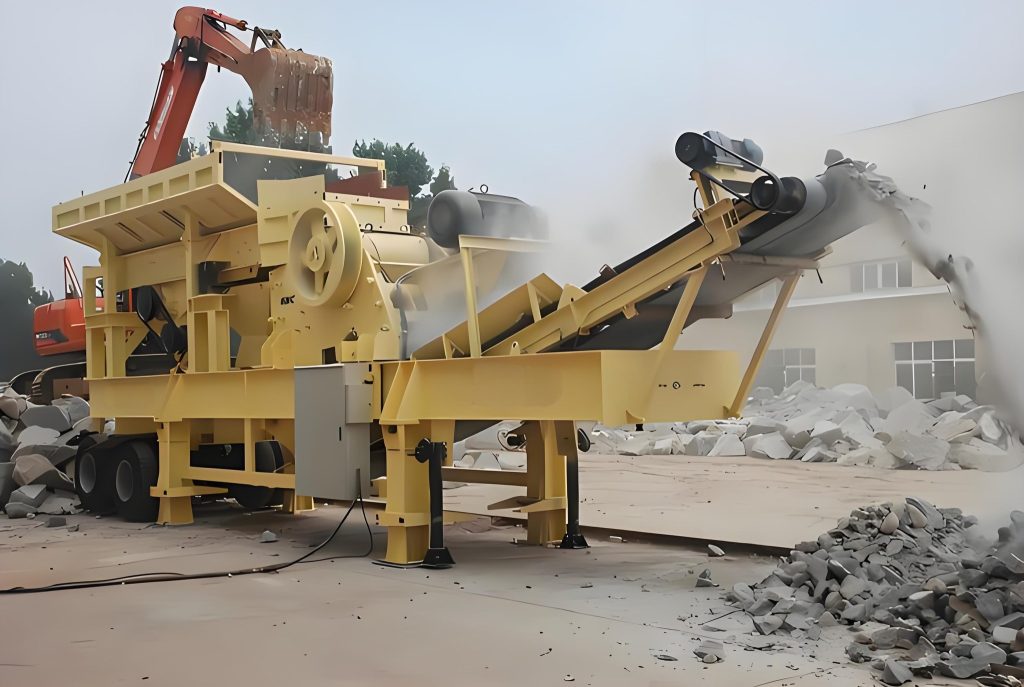
mobile crushing equipment
How Mobile Crushers Solve the Problem
Mobile crushing equipment fundamentally changes this workflow by introducing a “circular economy” model directly on-site. These units—typically mounted on tracked or wheeled chassis—are heavy-duty machines that can crush and screen various materials on the move.
Here is how they are specifically applied in road widening scenarios:
1. On-Site Material Recycling
Instead of hauling demolished concrete and asphalt (commonly known as RAP – Reclaimed Asphalt Pavement) away, mobile crushers process it immediately. The material is fed into the crusher, where jaws, cones, or impactors break it down into reusable aggregate. This transformed material can then be used immediately as a base course for the new road extension.
2. Reduced Logistics and Costs
By eliminating the round-trip trucking of waste and new materials, contractors see a dramatic reduction in operational costs. Fuel consumption drops, wear and tear on fleet vehicles decreases, and the project timeline shortens because there is no waiting for external material deliveries.
3. Immediate Base Layer Production
Road widening often requires a stable, compacted base before the final asphalt layer is laid. Mobile crushers can produce specific, calibrated aggregate sizes on demand. This “crush and fill” capability means that as soon as the old road is broken up, it can be processed and laid back down as a fresh sub-base, keeping the construction process continuous.
4. Accessibility in Confined Spaces
Road widening projects typically occur in linear, often confined spaces alongside active traffic lanes. Mobile crushing units are designed for this environment. Their compact design and high maneuverability allow them to move along the construction corridor easily, tucking into tight spaces where stationary plants could never fit.
Key Types of Mobile Crushers Used
Different stages of road widening require different crushing actions:
Mobile Jaw Crushers: Ideal for the primary reduction of large, chunks of reinforced concrete and rock. They are the workhorses of demolition and rough crushing.
Mobile Impact Crushers: Perfect for producing a higher quality, cubical shaped aggregate. They are excellent for processing concrete and asphalt that will be reused in higher-grade applications.
Mobile Cone Crushers: Used for secondary or tertiary crushing, these machines are essential when a very fine and consistent aggregate size is required for the upper layers of the road base.
Environmental and Community Benefits
Beyond the economic advantages, the use of mobile crushers aligns with global ESG (Environmental, Social, and Governance) goals:
Reduced Carbon Footprint: Less truck traffic means lower CO2 emissions.
Conservation of Resources: Using recycled aggregate preserves natural quarries and reduces landfill waste.
Less Community Disruption: Fewer heavy trucks on local roads mean less noise, dust, and safety hazards for residents near the construction zone.
The Future of Road Construction
As sustainability mandates become stricter and project timelines tighter, the adoption of mobile crushing equipment will only accelerate. Modern units are now incorporating smart technology, telematics, and hybrid diesel-electric drives to further reduce emissions and increase efficiency.
For contractors looking to stay competitive in the road widening sector, investing in or renting mobile crushing equipment is no longer just an option—it is a strategic necessity. It turns waste into wealth, speeds up project delivery, and builds a more sustainable infrastructure for the future.