Founded in 1987, Liming Heavy Industry specializes in the production of stationary crushers in medium and large models, mobile crushing plants, and ball mills. With over 30 years of technical experience, the company adopts advanced production technologies from the United States, Germany, Australia, and other countries. The company's professionalism and product quality are comparable to well-known international brands in the industry.
River Pebble Sand Making Production Line: Three-Stage Crushing Process
April 24th 2026
Based on our recent mass-balance audits of high-silica river gravel circuits, the biggest threat to profitability is not the upfront equipment price, but the hidden mechanical friction between incompatible crushing stages. River pebbles carry immense compressive strength and high quartz content. When operators force this abrasive material through a poorly synchronized two-stage setup, the metallic screech of high-quartz stone hitting a mismatched manganese liner is usually followed by a massive spike in expenditure per shift. The physics of material degradation demand a precise architectural approach to protect the capital payback velocity.
Overcoming Silica Abrasion in the Primary Cavity
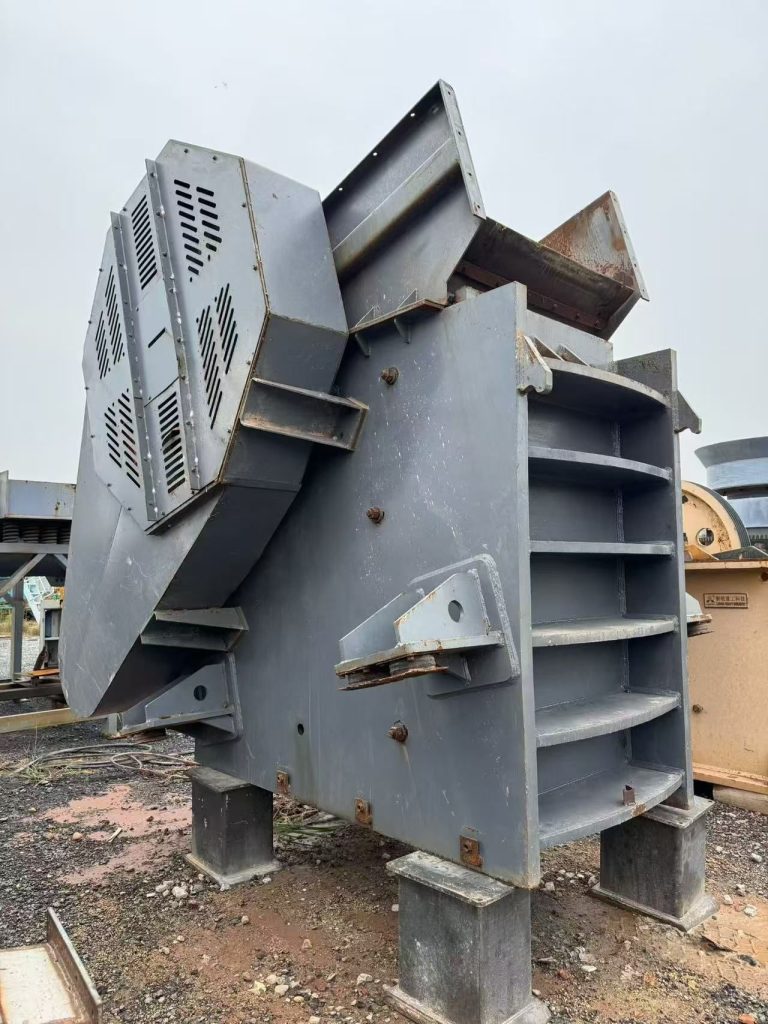
Deploying the C6X100 jaw crusher establishes a stable 130-420 tons per hour primary feed, preventing toggle plate failure under extreme compressive loads.
The initial fracture of river pebbles dictates the downstream efficiency of the entire plant. Operators often underestimate the erratic geometry of raw river stones. When material enters the primary chamber, the heavy-duty eccentric shaft of the C6X100 absorbs the immediate shock loads. You must maintain a steady feed rate to ensure the crushing cavity remains choke-fed, maximizing inter-particle crushing even at this early stage. This reduces the direct abrasion on the swing jaws.
C6X100 Primary Cavity absorbing shock loads from high-silica river gravel.
A poorly configured primary jaw creates an unpredictable output curve. This erratic discharge directly threatens the high-capacity secondary cone crusher by forcing it to process oversized slabs. We engineer the C6X100 with a precise nip angle to grip smooth pebbles firmly, preventing them from ‘boiling’ or bouncing within the V-shaped chamber. This mechanical intervention directly lowers the electrical draw on the 110 kilowatts motor.
Quality Balance: The Multi-Cylinder Secondary Stage
Operating the HPT300 at a precise 25mm closed side setting (CSS) guarantees continuous material flow without choking the tertiary phase.
Secondary crushing is where production lines either achieve rhythm or collapse under pressure. The HPT300 multi-cylinder cone crusher is designed for severe load applications. River pebble requires massive hydraulic force to shatter the internal crystalline structures. Relying on the microscopic tolerances of the HPT300 hydraulic cylinders, we stabilize the mantle and concave gap, ensuring a strict quality balance. If this gap drifts, the subsequent screening decks will instantly blind with oversized material.
Many plant managers ignore the surge bin before the secondary cone. You cannot feed an HPT300 directly from a primary conveyor without causing catastrophic amperage spikes on the 250 kilowatts motor. A dedicated surge bin ensures a consistent head of material, forcing the pebbles to grind against each other—a phenomenon known as autogenous crushing. This action significantly extends the lifespan of the costly wear liners.
Particle Shape Control: Tertiary Shaping Dynamics
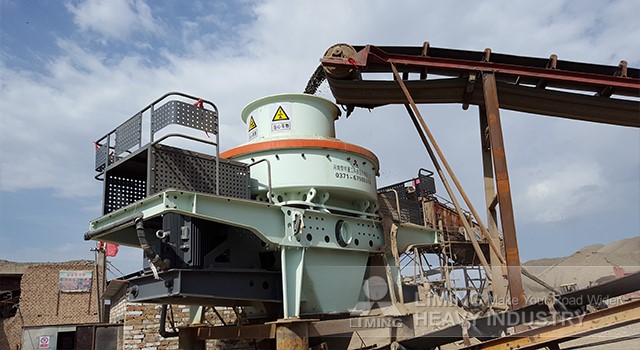
The VSI6X1040 forces rock-on-rock collisions at high rotational velocities to consistently strip micro-fractures and keep flaky particles strictly below 8%.
High-quality concrete demands cubic aggregate. The natural fracture patterns of river pebble tend to yield sharp, elongated splinters when processed only by compression crushers. To engineer the perfect aggregate, we route the 40mm output from the cone into the VSI6X1040 sand maker. The deep-rotor geometry accelerates the stone, using kinetic energy to drive rock-on-rock impacts. This violent aerodynamic environment rounds off the sharp edges.
VSI6X1040 Rotor forcing kinetic collisions to eliminate micro-fractures in river pebbles.
Controlling the powder ratio is equally critical. Operating the dual 200 kilowatts motors at peak efficiency requires balancing the air flow within the VSI chamber. If the exhaust system is poorly drafted, the crushing chamber becomes a pressurized dust trap, generating excessive heat that degrades the rotor bearings. Correct airflow management keeps the final sand washing requirement to an absolute minimum.
The Synchronized 300tph River Pebble Matrix
To handle the abrasive silica of river gravel at 300 tons per hour while maintaining an 8% flakiness ceiling, we have engineered the following circuit matrix based on strict mass-balance principles.
Process Stage
Recommended Model
Capacity (tons per hour)
Max Feed (millimeters)
Power (kilowatts)
Primary Crushing
C6X100 Jaw Crusher
130-420
630
110
Secondary Crushing
HPT300 Cone Crusher
110-440
230
250
Tertiary Shaping
VSI6X1040 Sand Maker
264-515
40
200~2
River Pebble Circuit Tolerance: 300tph Baselines
VSI6X1040 Max Feed Limit: 40 millimeters
Flakiness and Elongation Target: Strictly < 8%
C6X100 Primary Motor Rating: 110 kilowatts
HPT300 Secondary Capacity Range: 110-440 tons per hour
System-Wide Synchronization Goal: 300 tons per hour
Chief Architect’s Log: Eliminating Material Surges in 300tph River Pebble Systems
Why does the HPT300 cone crusher experience amperage spikes during the first hour of a shift? The cold start viscosity of the hydraulic oil resists immediate pressure equalization. If the operator feeds the full 300 tons per hour before the 250 kilowatts motor reaches its thermal baseline, the unyielding silica of the river pebble forces the concave to grind dry, spiking the electrical load instantly. How does a drifting CSS on the secondary cone affect the VSI6X1040? Looking at historical mass-balance failures, every millimeter of wear on the HPT300 mantle pushes oversized 45mm+ stones directly into the tertiary stage. The VSI6X1040 is engineered for a maximum feed of 40 millimeters; exceeding this threshold shatters the deep-rotor抛料头 (distributor plates) in days rather than months. What happens when you bypass the surge bin between the jaw and cone crushers? Directly coupling the C6X100 output to the HPT300 guarantees a choke-starve cycle. The cone crusher thrives on a continuous, dense feed to utilize layer crushing physics. Depriving it of this constant head creates uneven stress on the main shaft and accelerates eccentric bushing wear. Is it possible to achieve less than 8% flakiness without the VSI stage? The physics of compressive fracturing make this mathematically impossible with high-quartz stone. A cone crusher alone will always produce structural splinters along the natural fault lines of the pebble. Only the high-velocity kinetic impact of the VSI6X1040 can physically round those sharp edges.
Enforcing Particle Integrity Across High-Volume Silica Circuits
Failing to lock in the 25mm closed side setting on the secondary circuit guarantees a cascading failure of the entire mass-balance architecture, transferring massive wear-part costs onto the tertiary VSI rotor. Fix the upstream feed distribution next month, or you will be replacing the VSI distributor plates every 72 hours under the brutal abrasion of unprocessed river quartz.
Stop Guessing on Circuit Synchronization
“Prevent oversized silica from destroying your VSI rotors.” — From the Desk of your Solution Architect