Founded in 1987, Liming Heavy Industry specializes in the production of stationary crushers in medium and large models, mobile crushing plants, and ball mills. With over 30 years of technical experience, the company adopts advanced production technologies from the United States, Germany, Australia, and other countries. The company's professionalism and product quality are comparable to well-known international brands in the industry.
The Application of Impact Crushers in Highway Engineering Aggregate Production
February 9th 2026
Highway construction demands aggregates that meet stringent specifications for strength, durability, and performance. The quality of crushed stone used in base layers, asphalt concrete, and drainage systems directly influences the longevity and safety of the road. In this high-stakes production chain, the Impact Crusher has established itself as a critical technology for producing the high-quality, specially graded materials essential for modern highway engineering.
I. Why Highway Projects Favor Impact Crushers
The unique working principle of impact crushers—utilizing high-speed rotors to impart kinetic energy and shatter rock through impact—makes them exceptionally suited for producing highway-grade aggregates. Unlike compression crushers, impactors excel at creating the specific material characteristics required for roadbuilding.
1. Production of Superior Cubical Aggregates for Enhanced Stability
The impact crushing mechanism promotes inter-particle collision, resulting in a final product with a high percentage of cubical grains. This shape is non-negotiable for highway applications as it ensures optimal interlock and compaction in unbound base and sub-base layers.
Cubical aggregates reduce voids, enhance load distribution, and provide superior resistance to rutting and deformation under heavy traffic, directly extending pavement life.
2. Precise Gradation Control for Specific Structural Layers
Modern impact crushers offer excellent control over product gradation through adjustable rotor speed, impact apron gaps, and grinding path design. This allows producers to tailor crushed stone to exacting highway specifications:
Base & Sub-base Courses: Production of well-graded, angular aggregates (e.g., 0-40mm, 20-63mm) that achieve maximum density, stability, and drainage.
Asphalt Concrete (Wearing & Binder Courses): Consistent production of clean, cubical chips (e.g., 5-11mm, 11-16mm) for optimal binder adhesion, skid resistance, and fatigue resistance in the final pavement surface.
3. High Efficiency with Common Highway Construction Materials
Impact crushers are highly effective at processing the medium-hard to hard rocks (limestone, dolomite, certain granites) commonly used in highway projects.
They offer a high reduction ratio, often producing finished or near-finished product sizes in a single crushing stage. This streamlines the production circuit, making it efficient and energy-smart for high-volume highway material needs.
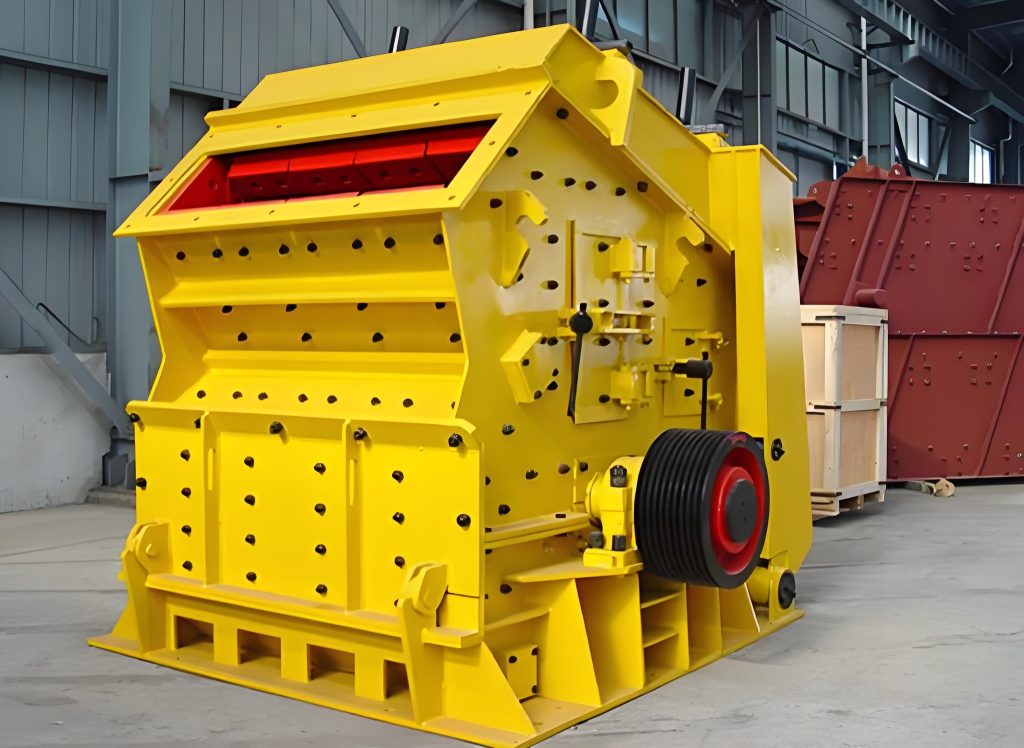
Impact Crushers
II. Key Advantages in the Highway Project Context
1. Operational Flexibility and Economic Efficiency
Impact crushers can be configured as primary or secondary crushers within an aggregate plant, offering significant layout flexibility. For many highway-spec materials, their design can offer a favorable balance of lower initial investment and easier maintenance compared to cone crushers.
Their high throughput capacity reliably supports the massive material demands of major highway and interstate projects.
2. Core Technology for Sustainable Road Construction: RAP Processing
A paramount modern application is the processing of Reclaimed Asphalt Pavement (RAP). Mobile or stationary impact crushers are exceptionally effective in sizing and rejuvenating RAP into high-quality recycled aggregates for reuse in new asphalt mixes or base layers. This practice is central to sustainable, cost-effective highway maintenance and rehabilitation.
3. Unmatched Value from Mobile Crushing Setups
Mobile Impact Crushers are invaluable for on-site crushing during highway widening, rehabilitation, or remote projects. They eliminate the need to transport raw material to distant stationary quarries and haul back processed aggregate, yielding dramatic reductions in cost, truck traffic, fuel consumption, and project carbon footprint.
III. Standard Production Workflow for Highway Aggregates
A typical high-yield circuit for highway materials often features:
Primary Jaw Crusher: Performs initial size reduction of quarry-run rock.
Secondary/Tertiary Impact Crusher: Further crushes the material, optimizing its shape and final sizing. A closed-circuit system with an inclined screen is standard to recirculate oversize material, ensuring precise gradation control critical for highway specs.
Final Screening & Stockpiling: Multiple-deck vibrating screens separate the crushed product into the specific fractions required for different road layers (e.g., #57 stone, #8 stone, manufactured sand).
IV. Conclusion: The Strategic Choice for Durable, High-Performance Highways
For aggregate producers, road contractors, and civil engineering firms focused on highway construction, the impact crusher is more than machinery—it is a strategic asset for quality assurance and project economics.
By delivering aggregates with the optimal combination of strength, precise gradation, and superior cubical shape, impact crushers directly contribute to building road foundations that are more stable, pavement surfaces that are more durable, and ultimately, transportation infrastructure that is safer, requires less maintenance, and delivers a lower lifecycle cost.
When a project’s success hinges on the quality of its granular layers and pavement materials, specifying aggregates produced by a well-configured impact crushing system is a decision grounded in both sound engineering and long-term value.