Founded in 1987, Liming Heavy Industry specializes in the production of stationary crushers in medium and large models, mobile crushing plants, and ball mills. With over 30 years of technical experience, the company adopts advanced production technologies from the United States, Germany, Australia, and other countries. The company's professionalism and product quality are comparable to well-known international brands in the industry.
Impact Crushers: Applications, Advantages, and Disadvantages
September 24th 2025
The impact crusher is a versatile and powerful machine used in a wide range of industries, from quarrying and mining to construction and demolition recycling. Unlike a jaw or cone crusher that uses compression to break rock, an impact crusher works on a different principle: impact force.
This comprehensive guide will provide a clear overview of the primary uses of an impact crusher, as well as its key advantages and disadvantages to help you determine if it’s the right choice for your project.
How an Impact Crusher Works
An impact crusher uses a rotor with hammers or blow bars that spin at a very high speed. Material is fed into the crushing chamber and is violently struck by the hammers. The material shatters and is thrown against a series of impact plates (or aprons) inside the chamber for further reduction.
There are two main types of impact crushers:
Horizontal Shaft Impact (HSI) Crushers: Used for primary and secondary crushing of soft to medium-hard materials.
Vertical Shaft Impact (VSI) Crushers: Primarily used for tertiary (fine) crushing and shaping, using a “rock-on-rock” or “rock-on-steel” principle.
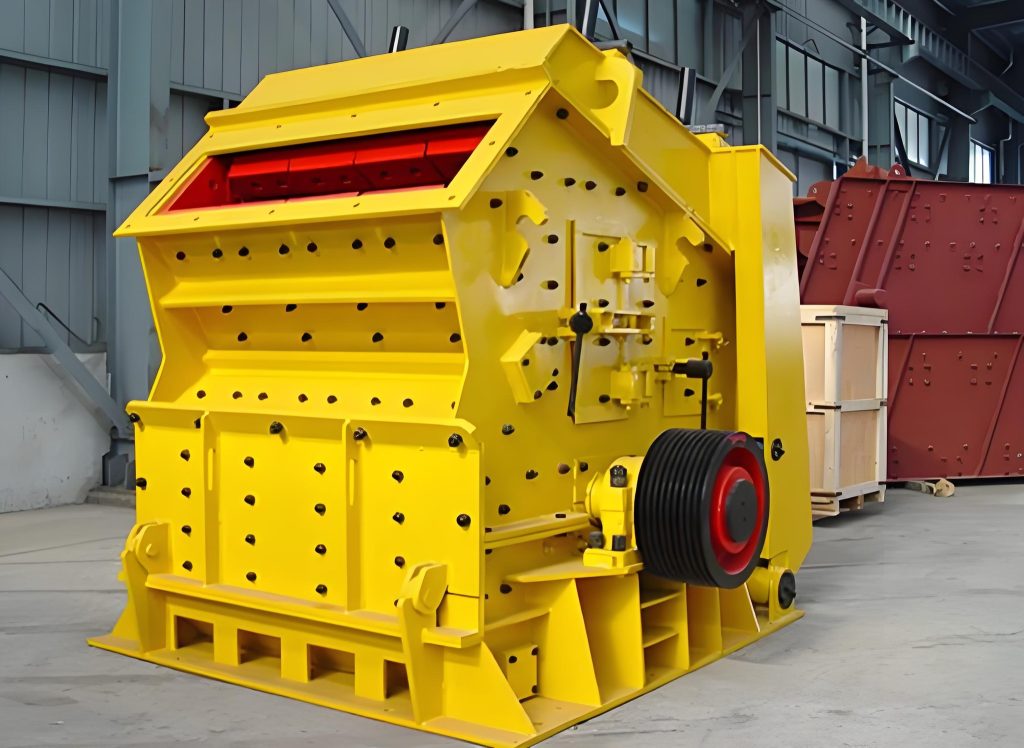
Impact Crushers
Primary Applications of an Impact Crusher
The unique working principle of an impact crusher makes it the ideal choice for several specific applications:
Limestone and Soft to Medium-Hard Rocks: This is the most common and ideal application. Materials like limestone, dolomite, and sandstone are brittle and shatter easily under impact, making them perfect for this type of crusher.
Recycled Aggregates:Impact crushers are the go-to machine for recycling concrete, asphalt, and other demolition waste. The impact action efficiently breaks the material while a magnetic separator can be used to pull out rebar and other steel for recycling.
Production of High-Quality Cubical Aggregates: The VSI crusher, in particular, is the industry standard for producing a high percentage of cubical-shaped aggregates. This is highly desirable for asphalt and concrete production, as the uniform shape leads to a stronger, more stable final product.
Advantages of an Impact Crusher
Superior Product Shape: The most significant advantage. The shattering action produces a cubical, well-shaped product with minimal elongated or flaky particles, which increases its market value.
High Reduction Ratio: An impact crusher can achieve a large size reduction in a single pass, often eliminating the need for a second-stage crusher. This simplifies the crushing circuit and reduces overall costs.
High Capacity and Efficiency: The high-speed crushing action leads to a high throughput, making it a very productive machine.
Versatility: It can handle a wide range of materials, from soft rock to recycled concrete, making it a flexible choice for various projects.
Disadvantages of an Impact Crusher
High Wear Rate: This is the most significant drawback. The constant, violent impact causes rapid wear on the hammers, blow bars, and impact plates, especially when crushing hard or abrasive materials like granite, basalt, or iron ore. This leads to higher maintenance costs and increased downtime.
Not Ideal for Hard, Abrasive Rocks: Due to the high wear rate, impact crushers are not the best choice for crushing extremely hard, abrasive materials as a primary or secondary crusher. In these applications, a cone crusher is typically the more economical option.
Sensitivity to Foreign Materials: Large uncrushable materials, like steel scrap, can enter the chamber and cause significant damage to the rotor and other internal components.
Higher Production of Fines: The crushing action can produce a higher percentage of fine material (dust) than compression-style crushers.
In conclusion, the impact crusher is a powerful and efficient machine, but its effectiveness is highly dependent on the material it’s processing. While it is not the best choice for all applications, its ability to produce a superior product shape and its high efficiency with specific materials make it an indispensable tool for modern aggregate production and recycling.