Founded in 1987, Liming Heavy Industry specializes in the production of stationary crushers in medium and large models, mobile crushing plants, and ball mills. With over 30 years of technical experience, the company adopts advanced production technologies from the United States, Germany, Australia, and other countries. The company's professionalism and product quality are comparable to well-known international brands in the industry.
Impact Crusher Selection Guide: Matching Machine to Feed Particle Size
September 26th 2025
Choosing the right impact crusher is one of the most critical decisions in establishing an efficient crushing operation. While factors like capacity and final product size are important, the single most defining factor for crusher selection is the size of the incoming material, known as the feed particle size. A mismatch between the crusher’s design and the feed size can lead to catastrophic damage, frequent clogging, and crippling inefficiency.
Why Feed Particle Size Dictates Crusher Selection
The design of an impact crusher—including the dimensions of its crushing chamber, the size and power of the rotor, and the configuration of its impact plates—is engineered for a specific maximum and optimal feed range.
Mechanical Constraint: If the feed particle size is too large, the material will jam in the entrance or the crushing chamber, leading to significant downtime and potential structural damage to the rotor or breaker plates.
Efficiency and Wear: If the feed is too small for a primary-sized crusher, energy is wasted, and the impact action is less effective. Conversely, using the wrong size machine for a large feed dramatically increases wear on the internal components, leading to higher maintenance costs.
Throughput: The machine’s designed throughput is only achievable when the feed size is properly managed, allowing for a steady, continuous flow of material.
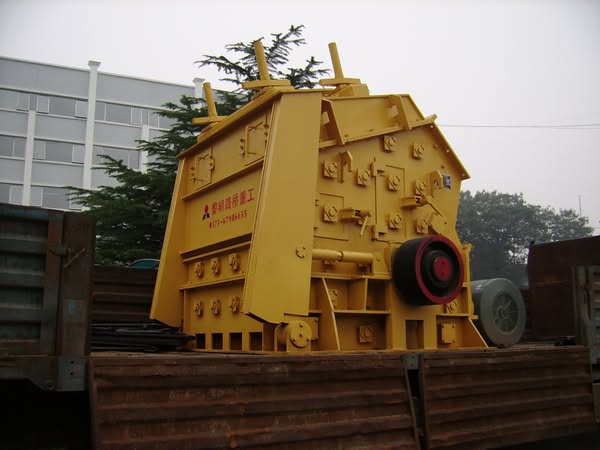
impact crusher
Impact Crusher Types and Ideal Feed Size
Impact crushers are highly versatile but are typically classified based on their role in the crushing sequence, which directly correlates to the feed particle size they are designed to handle:
Application Stage
Typical Machine Type
Key Feed Particle Size Range
Selection Focus
Primary Crushing
Heavy-Duty Impact Crusher
Large (e.g., up to 800-1000 mm)
Robust frame, large feed opening, and high inertia to handle massive, unprocessed quarry material.
Secondary Crushing
Standard Impact Crusher (PFC/PF Series)
Medium (e.g., 300–500 mm)
Ideal for material pre-crushed by a jaw crusher or for processing demolished concrete. Focus is on high reduction ratio and optimal shaping.
Tertiary Crushing
Impact/VSI Crusher (for shaping)
Small (e.g., below 50 mm)
While often used as a tertiary or shaping machine, a standard impact crusher can be used. The focus here is on high rotor speed to ensure a uniform, cubical final product for aggregate production.
The critical takeaway is that the chosen crusher must have a feed opening wide enough to comfortably accept the largest pieces of material, and a crushing chamber deep enough to handle the material’s volume as it’s processed.
Liming Heavy Industry: Matching Your Feed Size to the Perfect Machine
Achieving optimal throughput and product quality requires precise crusher selection—a commitment to engineering excellence that Liming Heavy Industry champions. We understand that feed variability is a reality in mining and recycling operations.
Liming Heavy Industry offers a comprehensive range of impact crushers designed with robust, heavy-duty rotors and precision-engineered crushing chambers tailored to specific feed particle sizes. Our technical experts work closely with clients to analyze their raw material characteristics (size, hardness, moisture) to recommend the exact model and configuration that will ensure maximum efficiency and minimal wear parts consumption. Our focus is on providing reliable crushing equipment that is optimized for your specific material input.
Optimizing Throughput Through Proper Selection
Correct impact crusher selection based on feed particle size is not optional; it is essential for achieving peak operational efficiency. By understanding the capabilities of your equipment and ensuring a proper match with the incoming material, you can successfully prevent bottlenecks, reduce unexpected downtime, and maintain a steady, high-quality output for your aggregate production.