Founded in 1987, Liming Heavy Industry specializes in the production of stationary crushers in medium and large models, mobile crushing plants, and ball mills. With over 30 years of technical experience, the company adopts advanced production technologies from the United States, Germany, Australia, and other countries. The company's professionalism and product quality are comparable to well-known international brands in the industry.
The Role of the Cone Crusher in Basalt Crushing Process
November 21st 2025
Basalt, with its high compressive strength, density, and abrasive silica content, is one of the most challenging materials for aggregate producers. Processing this hard rock into high-quality aggregates requires a robust and efficient crushing circuit. While jaw crushers handle the primary breaking, the cone crusher plays an indispensable and specialized role in the secondary and tertiary stages, shaping the final product and determining the overall efficiency of the basalt crushing process.
Superior Reduction and High Capacity in Secondary/Tertiary Crushing
The cone crusher is the workhorse for intermediate and fine crushing, taking the pre-crushed material from the primary jaw crusher and reducing it further.
High Reduction Ratio: Cone crushers are engineered to achieve significant size reduction in a single pass. This efficient comminution is crucial for maximizing the overall yield of the plant and preparing the material for final sizing.
Continuous, High-Volume Processing: Operating on the principle of continuous compression, cone crushers can handle large volumes of basalt feed material, ensuring a steady and high-capacity flow through the entire crushing circuit.
Ideal for Hard Rock: Their powerful crushing action and sturdy construction are specifically designed to withstand the extreme stresses generated by crushing dense and abrasive materials like basalt.
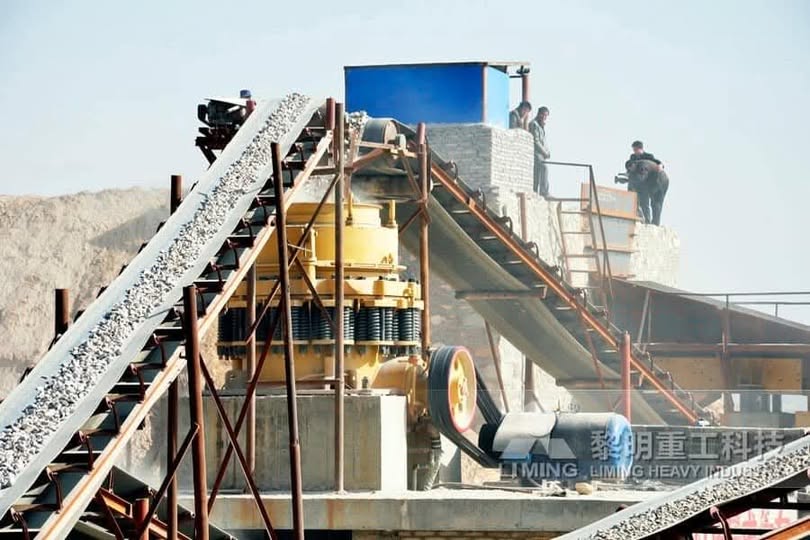
cone crusher
Production of High-Quality, Cubical Aggregates
This is perhaps the most significant value a cone crusher adds to a basalt processing plant. The quality of the final product is paramount.
Excellent Particle Shape: The inter-particle compression (rock-on-rock crushing) that occurs in the chamber produces a consistent, cubical product. This shape is critical for high-strength concrete and asphalt applications, as it provides better compaction and mechanical interlock.
Controlled Gradation: Modern cone crushers allow for precise adjustment of the Closed Side Setting (CSS). This enables operators to fine-tune the output to meet strict product specifications, producing everything from coarse aggregates to finer chips.
Consistent Output: Even with variations in feed size or hardness, a well-configured cone crusher maintains a stable and consistent product gradation, which is essential for downstream processes and product quality assurance.
Durability and Cost-Effectiveness in Abrasive Environments
The abrasive nature of basalt is a primary concern for operational costs. Cone crushers are built to manage this challenge effectively.
Wear-Resistant Liners: Critical components like the mantle and concave are made from high-grade manganese steel or other advanced alloys. These materials are designed to work-harden during operation, extending their service life against basalt’s severe abrasion.
Automated Wear Compensation: Many modern cone crushers feature hydraulic adjustment systems that can automatically compensate for liner wear. This maintains a consistent product size without manual intervention, ensuring optimal performance until the liners are scheduled for replacement.
Lower Cost per Ton: While the initial investment and liner costs are factors, the combination of high throughput, extended liner life, and minimal downtime results in a lower operating cost per ton of crushed basalt over the long term.
Conclusion: The Heart of the Modern Basalt Crushing Circuit
In summary, the role of the cone crusher in the basalt crushing process is fundamental and irreplaceable. It is the key machine responsible for transforming primary-crushed rock into a high-value, specification-grade product. Its ability to deliver high reduction ratios, superior particle shape, and reliable operation in an abrasive environment makes it the core of an efficient and profitable hard rock crushing plant. For any producer focusing on basalt, selecting the right cone crusher technology is a strategic decision that directly impacts product quality and bottom-line profitability.