Founded in 1987, Liming Heavy Industry specializes in the production of stationary crushers in medium and large models, mobile crushing plants, and ball mills. With over 30 years of technical experience, the company adopts advanced production technologies from the United States, Germany, Australia, and other countries. The company's professionalism and product quality are comparable to well-known international brands in the industry.
Why Construction Sites Prefer Mobile Crushing Equipment
December 26th 2025
In the fast-paced, dynamic environment of modern construction and infrastructure projects, efficiency, flexibility, and cost control are paramount. The traditional model of hauling raw materials to a distant fixed crushing plant is increasingly being challenged. Today, mobile crushing equipment—track-mounted or wheeled crushers and screens—has become the preferred choice for a growing number of contractors and site managers. This shift is not a trend but a strategic response to the core demands of contemporary project execution. This article explores the compelling reasons why construction sites are leaning so heavily toward mobile crushing solutions.
1. Unmatched Mobility and Rapid Deployment
Construction sites are temporary by nature, and timelines are tight. Mobile crushing plants excel in this context.
Go Where the Material Is: The equipment can be driven or towed directly to the exact location of the raw material—be it a demolition pile, a rocky outcrop needing excavation, or a stockpile at the far end of a large site. This “crush-at-source” principle is revolutionary.
Quick Setup and Teardown: Unlike fixed plants requiring permanent foundations and complex infrastructure, mobile units can be set up and operational in hours or days. Once the project phase is complete, they can be just as quickly relocated to the next site or task, maximizing asset utilization.
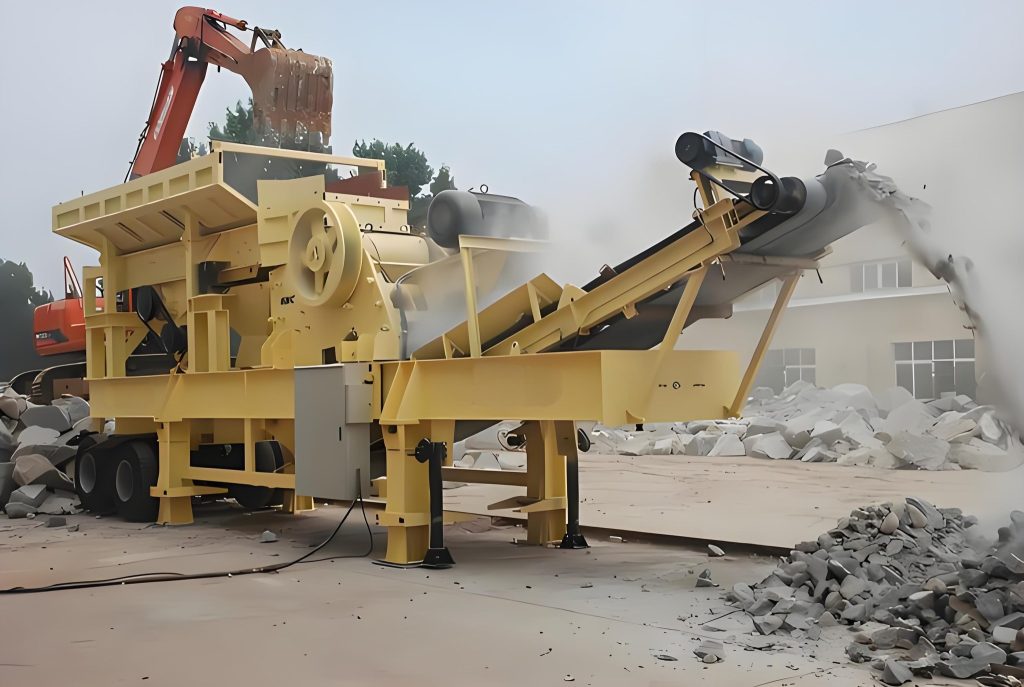
mobile crushing equipment
2. Dramatic Reduction in Material Transport Costs
Transportation is one of the largest cost centers in material processing. Mobile crushers attack this cost head-on.
Eliminate Haulage of Raw Material: The most significant saving. Instead of paying for trucks to move tons of unprocessed rock, concrete, or asphalt to a distant plant, processing happens on-site. The cost of moving the finished, denser aggregate is far lower.
Optimize On-Site Logistics: The plant can be repositioned to follow the work progress (e.g., along a road construction corridor), minimizing internal haul distances for loaders and dump trucks.
3. Superior Flexibility and Project Adaptability
No two construction sites are identical, and plans often change. Mobile equipment provides the necessary agility.
Handle Multiple Materials: A single mobile setup (e.g., a jaw-impactor combo) can process natural rock, recycled concrete, and asphalt, adapting to the site’s evolving feedstock.
Right-Size for the Task: Equipment can be selected to match the specific volume and output requirements of a project, avoiding the overcapacity and expense of a permanent fixed plant.
Ideal for Confined Urban Sites: Compact, self-propelled track-mounted units can operate in tight spaces common in urban demolition and redevelopment projects where space is a premium.
4. On-Demand Production and Direct Material Reuse
Mobile plants turn waste into a resource and ensure just-in-time material supply.
Create Value from Waste: Demolition concrete and asphalt are processed into high-quality recycled aggregate (RAP, RCA) right on site. This turns a disposal cost into a revenue stream and supports sustainable construction practices.
Produce Exactly What You Need: The aggregate can be sized and graded to meet the specific requirements of the project’s next phase, whether for road base, backfill, or drainage layers, ensuring immediate reuse.
5. Enhanced Efficiency and Project Timeline Management
Time is money. Mobile crushing streamlines the production chain.
Faster Project Start: Production can begin almost immediately after the unit arrives, without waiting for plant construction.
Reduced Dependency on External Suppliers: The site gains control over a critical part of its material supply chain, mitigating risks of delay or price volatility from external aggregate suppliers.
Continuous Workflow: The ability to keep processing and reuse operations tightly integrated with excavation and construction activities creates a smoother, more efficient overall workflow.
6. Improved Environmental and Community Impact
Modern construction must consider its surroundings. Mobile plants offer distinct advantages.
Lower Carbon Footprint: By drastically reducing truck traffic for hauling raw waste and importing new aggregate, sites significantly cut fuel consumption and associated emissions.
Reduced Noise and Dust Disturbance (Localized): While the crusher itself generates noise and dust, its impact is confined to the immediate, controlled site area rather than being spread along public haul routes. Advanced models come with integrated dust suppression and noise abatement kits.
Less Site Disturbance: Minimal ground preparation is needed compared to building a fixed plant, preserving the site’s natural state.
Comparison: Mobile vs. Fixed Plant for a Typical Construction Site
Very long-term, high-volume quarrying at a single location.
Conclusion: A Strategic Shift Towards Agility and Control
Construction sites are not merely “using” mobile crushing equipment; they are strategically adopting it to solve fundamental challenges of cost, time, and logistics. The preference stems from a clear economic and operational logic: why transport the problem when you can bring the solution?
The combined benefits of radically lower transport costs, unparalleled project flexibility, the ability to monetize on-site waste, and faster project timelines make mobile crushing an indispensable tool for the modern contractor. It represents a shift towards self-sufficiency, efficiency, and sustainable practices, giving project managers direct control over a critical path item—their aggregate supply. In an industry where margins are tight and schedules are tighter, the choice to go mobile is increasingly becoming the standard, not the exception.